
Introduction
Muzzle training is the process of gradually conditioning your dog to wear a muzzle comfortably and voluntarily through positive reinforcement. Rather than forcing a muzzle onto a stressed or scared pet, proper muzzle training builds a positive association so that your dog views the muzzle as a neutral-or even enjoyable-part of their routine. All dogs can benefit from learning to wear a muzzle, whether they need one regularly or only in unexpected situations.
This guide covers everything from selecting the right muzzle and measuring for proper fit to executing a phased training protocol that keeps your dog relaxed and cooperative. It is designed for owners of reactive dogs, dogs requiring frequent veterinary care or grooming, and proactive pet parents who want emergency preparedness. Punishment-based methods fall outside the scope of this guide; every technique here relies on reward-based training that is recommended for successfully introducing muzzles.
In short: muzzle training involves gradual positive conditioning using treats and games to create comfort with muzzle wearing, and most dogs reach stable, comfortable wearing in approximately 2–4 weeks of daily short sessions.
By the end of this guide, you will understand how to:
- Achieve stress-free vet visits and medical care with a muzzle-conditioned dog
- Enable safe public outings alongside other dogs and strangers
- Prepare your dog for emergencies or surgery recovery
- Use muzzle training as a behavioral management tool-not a punishment
- Build handler confidence through a reliable, humane safety plan
Understanding Muzzles and Their Purpose
A muzzle is a protective device fitted over a dog’s mouth and snout to prevent biting while still allowing natural behaviors like panting, sniffing, and the ability to drink water. A basket-style muzzle is generally preferable for safety and comfort because it permits airflow and treat delivery through the openings, making it compatible with positive reinforcement training. Muzzles are absolutely not a sign of a “bad dog”-they are a practical safety tool used by responsible owners worldwide.
Muzzle training ensures safety during veterinary exams and emergencies, and it also helps reduce stress during recovery from medical procedures where a dog might bite at sutures or bandages. For dogs undergoing behavioral modification, a muzzle provides a critical safety layer that allows training to proceed with lower risk to humans and other animals.
When Muzzle Training is Necessary
Several scenarios make starting muzzle training not just helpful but essential:
- Dogs with a bite history or aggressive tendencies. Any dog that has bitten or shown aggression toward people or other dogs benefits from muzzle conditioning as a safety protocol. Muzzle training is not a substitute for addressing aggression or fear issues, but it creates a safer environment while those issues are being worked on.
- Fearful or anxious dogs requiring medical care. A nervous dog at the vet may snap out of pain or fear. A muzzle-trained pet can undergo exams calmly without the need for heavy restraint.
- Dogs that eat dangerous objects during walks. Some dogs compulsively pick up rocks, garbage, or other harmful items. Muzzle training prevents dogs from eating harmful items on walks while still allowing them to sniff and explore.
- Proactive preparation. Even a gentle, friendly dog may need a muzzle after surgery or during an emergency. Teaching acceptance before a crisis means you won’t have to force an unfamiliar device onto an already stressed animal.
Proper training makes necessary muzzle use humane and stress-free, transforming what could be a frightening experience into a routine one.
Benefits Beyond Safety
Muzzle training benefits dogs and owners beyond managing reactivity. Research published in Applied Animal Behaviour Science found that in a study of 97 shelter dogs, those handled with basket muzzles showed significantly fewer fear behaviors and escape attempts compared to dogs restrained with soft muzzles, muzzle-hold techniques, or full-body restraint (p<0.001). This means a properly trained, muzzled dog actually experiences less stress during veterinary procedures than one subjected to physical holding.
Additional benefits include:
- Reduced restraint during medical procedures. A dog that is comfortable wearing a muzzle requires less handling from vet staff, which lowers overall stress for everyone involved.
- Calmer behavior in stressful situations. When a dog has been conditioned to associate the muzzle with positive experiences, the muzzle itself can become a calming cue rather than a source of anxiety.
- Owner peace of mind. Walking a reactive dog in public becomes less anxiety-inducing when you know a muzzle is in place and your dog is comfortable wearing it.
Training transforms muzzles from a tool of restriction to a comfort tool-and choosing the right muzzle type is crucial for successful training.
Muzzle Selection for Training Success
The muzzle you choose directly determines whether training succeeds or stalls. A poorly chosen muzzle that restricts your dog’s mouth, prevents panting, or blocks treat delivery will undermine every positive association you try to build. Muzzle type should match the dog’s breed and size for both safety and comfort.
Basket Muzzles
Basket muzzles are the gold standard for muzzle training because they allow dogs to pant and drink water, accept treats through the openings, and maintain normal facial expressions. Three widely recommended models include:
- Baskerville Ultra – A flexible rubber basket muzzle with a padded nosepiece, widely recommended by veterinary behaviorists. The Baskerville Ultra is a recommended type of basket muzzle that works well for most dogs due to its comfort and adjustability.
- Italian Basket Muzzle – A wire or coated-wire design that offers excellent ventilation, particularly useful in warm or humid conditions.
- Jafco Clear Vinyl Muzzle – A transparent hard-plastic option that allows visibility of the dog’s mouth and is easy to clean.
All three models support treat delivery through the basket openings, which is essential for building and maintaining positive associations during training sessions. According to Cornell University’s College of Veterinary Medicine, basket muzzles that permit panting, drinking, and sniffing are the only appropriate choice for training protocols.
Sizing and Fit Requirements
Proper fit is non-negotiable. An ill-fitting muzzle causes discomfort, rubbing, or pressure points that will make your dog resist wearing it regardless of how many treats you offer. Key measurements include:
- Snout length – Measure from the tip of the nose to the base of the stop (where the snout meets the forehead).
- Snout circumference – Measure around the widest point of the snout with the mouth slightly open.
- Under-strap fit – One to two fingers should fit comfortably under any strap touching the dog’s head or neck.
The muzzle should allow your dog to open their mouth partially, extend their tongue to pant and lick, and accommodate the ears without pinching. If your dog is still a puppy, plan to adjust sizing as their facial dimensions change. Professional fitting at a training facility can save significant time and prevent setbacks caused by comfort issues.
Muzzles to Avoid for Training
Cloth muzzles restrict panting and can cause overheating-a serious welfare concern, especially during exercise or in warm weather. Nylon muzzles are not suitable for most situations because they hold the dog’s mouth closed, preventing them from eating treats, panting to cool down, or drinking. Research on canine welfare confirms that restrictive muzzle types pose risks of heat stress and dehydration, particularly during exertion or in humid conditions.
Cloth muzzles and fabric sleeve types also make positive conditioning nearly impossible: if you can’t feed treats through the muzzle, you cannot build the associations that make training work. These muzzles may have a place for extremely brief, controlled situations (a few minutes at the vet), but they should never be used as training tools.
With the right muzzle selected and properly fitted, you’re ready to begin an effective training protocol.

Step-by-Step Muzzle Training Protocol
Building on proper muzzle selection, the training process follows a phased approach that respects your dog’s pace. Sessions should be short to avoid stressing the dog during muzzle training-aim for 5–10 minutes per session, multiple times per week. Building positive associations is critical in muzzle training, so every phase revolves around making the muzzle predict good things. Puppyhood is an ideal time to start muzzle training, but dogs of any age can learn this skill.
Choose high-value treats to facilitate positive experiences during muzzle training. Think about what your dog loves most: string cheese, deli chicken, freeze-dried liver, or peanut butter all work well. The treats need to be exciting enough that the dog’s attention stays on the reward rather than on the unfamiliar object near their face.
Phase 1: Introduction and Nose Conditioning
The goal of this phase is to build positive associations before any actual wearing takes place. No straps are fastened, no pressure is applied-your dog sets the pace entirely.
- Present and reward curiosity. Set the muzzle on the ground near your dog. Every time they look at, sniff, or investigate it, mark the behavior and feed treats. If your dog is too scared to approach, place the muzzle near their food bowl during meals so it becomes part of the environment.
- Encourage nose touching. Use a point or touch cue to guide your dog’s nose toward the muzzle opening. Reward each touch with a high-value treat. Repeat until the dog voluntarily moves toward the muzzle without hesitation.
- Lure the nose inside. Smear peanut butter or spray cheese on the inside of the basket so your dog must put their nose inside the muzzle to lick it off. This creates a self-rewarding experience-the muzzle becomes a fun food puzzle.
- Reward voluntary insertion. Once your dog puts their nose inside the muzzle willingly, feed treats through the basket openings while their nose remains inside. The dog learns that putting their nose in the muzzle produces excellent outcomes.
This phase typically takes several days to a week. Don’t rush. If your dog hesitates at any point, go back to the step where they were confident and practice there longer.
Phase 2: Duration and Fastening
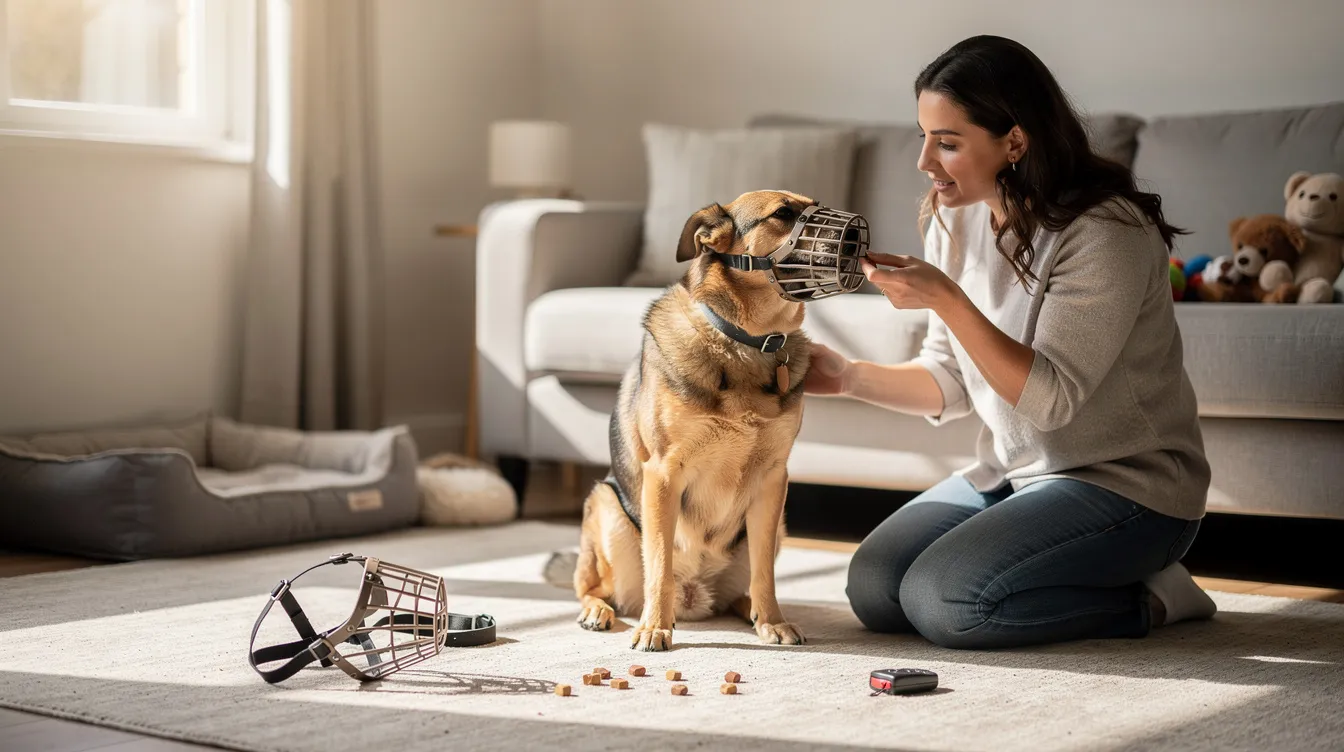
Once your dog enthusiastically pushes their nose inside the muzzle on cue, you can begin building duration and introducing the strap. Introducing straps should be done gradually for comfort. Training should include comfort with the muzzle and strap as separate skills before combining them.
- Extend nose-in duration. After the dog puts their nose in, wait a few seconds before delivering the treat. Start with 2–3 seconds and gradually work up. Use high-value food like cheese or bits of chicken to maintain motivation during the longer waits.
- Introduce strap contact. Before actually fastening the strap, practice touching it to the side of your dog’s head, lifting it, and letting it drop-rewarding each step. This prevents the snap of the buckle from startling your dog.
- Brief fastening with continuous rewards. Fasten the strap for just a moment, immediately feed treats through the muzzle, then unfasten. The dog should barely notice the strap because they’re focused on the food. Build up to 30–60 seconds of comfortable wearing with the strap secured.
- Make fastening routine. Practice putting the muzzle on and taking it off multiple times per session so the entire process feels normal and predictable. Always end on a successful note.
A realistic benchmark: most dogs reach stable, fastened wearing of 30–60 seconds within 2–4 weeks of consistent short training sessions. Use continuous reinforcement (treat every few seconds) during early fastened wear, then gradually shift to intermittent reinforcement as comfort builds.
After your dog tolerates fastened wearing indoors, begin practicing during walks in your yard or house, then progress to outdoor environments with low distractions. Pair muzzle wear with activities your dog loves-a walk around the block, a game in the yard, or even feeding time. This generalization prevents the muzzle from becoming exclusively associated with stressful events like vet visits.
Training Games and Techniques
Games make muzzle training fun rather than clinical. Here are four techniques that keep energy high and associations positive:
- Licky Sticky. Apply spray cheese, Kong Stuffn’ Easy, or peanut butter inside the basket. Your dog has to push their nose inside and lick to get the food. This game is especially effective during the introduction phase and can be used throughout training to maintain enthusiasm.
- Dinner Time. Feed your dog’s regular meals through a properly fitted basket muzzle. Place kibble or wet food inside so the dog must wear the muzzle to eat. This teaches that the muzzle means food is coming.
- Cup Game. Start by teaching your dog to touch a cup with their nose on cue, then transition that touch behavior to the muzzle opening. This gives the dog a sense of control-they’re performing a learned skill, not being subjected to an unfamiliar process.
- Chase Me. Hold the muzzle and move away playfully, encouraging your dog to follow. When they catch up, present the muzzle opening with a treat inside. This builds excitement around the muzzle rather than apprehension.
These games work because they let the dog drive the interaction. The dog chooses to engage, which develops confidence and willing participation.
Common Training Challenges and Solutions
Even with careful planning, most dogs hit at least one sticking point during muzzle training. Recognizing problems early and adjusting your approach prevents small setbacks from becoming entrenched resistance. If challenges persist, professional consultation can help-especially for dogs with fear-based reactivity or complex behavioral histories.
Dog Refuses to Approach Muzzle
If your dog won’t go near the muzzle, the introduction pace is too fast or the muzzle itself may have a negative association (perhaps from a previous experience). Slow down dramatically. Place the muzzle on the floor several feet from your dog’s food bowl and leave it there during meals for a few days without any interaction requirements. Use higher-value treats-if you’ve been using kibble, switch to string cheese or boiled chicken. Some dogs respond better when the muzzle smells like something they love, so rubbing it with a bit of cheese or liver paste can encourage that first sniff.
Pawing or Trying to Remove Muzzle
When a dog paws at the muzzle after fastening, it typically signals either discomfort from fit or insufficient conditioning before the fastening step. First, check fit: ensure the nose tip isn’t pressing against the end of the basket and that straps aren’t pulling on the ears. If fit is correct, the dog likely needs more time at the “nose in without fastening” stage.
Distraction helps significantly. Immediately after fastening, start a walk on leash, practice obedience cues your dog already knows, or initiate a brief exercise like “touch” or “place.” Keeping training sessions short-removing the muzzle before the dog feels the need to paw-builds tolerance more effectively than waiting for frustration to appear.
Freezing or Stress Signals
Watch for lip licking, yawning, whale eye, a tense body, or complete freezing. These indicate the dog is overwhelmed. When stress signals appear, return to the previous successful step and rebuild confidence gradually from there. Don’t push through stress hoping the dog will “get used to it”-this approach typically backfires and can make the dog scared of the muzzle altogether.
For dogs with deep fear responses, a behavior modification program that addresses the underlying anxiety may be necessary before muzzle training can progress. Desensitization and counterconditioning protocols, guided by a professional, can help these dogs develop comfort that treat-based training alone may not achieve.
Conclusion and Next Steps
Successful muzzle training creates a reliable safety tool without stress, fear, or force. When done through gradual positive conditioning, most dogs learn to view the muzzle as just another piece of equipment-no different from a leash or harness. The process requires patience, consistency, and high-value rewards, but the payoff is substantial: a dog that can be safely handled during vet visits, walked confidently in public spaces, and managed effectively during emergencies.
To get started:
- Select a properly fitted basket muzzle such as the Baskerville Ultra or Italian Basket model, measured to your dog’s snout length and circumference.
- Begin the introduction phase by letting your dog investigate the muzzle at their own pace, rewarding every interaction.
- Practice 5–10 minutes daily, keeping training sessions short and always ending on a positive note.
- Generalize the skill by practicing muzzle wear during walks, play, and routine activities-not only before stressful events.
If your dog has a history of aggression, severe reactivity toward other dogs on walks, or extreme fear responses, working with a professional trainer can accelerate progress and prevent setbacks. Muzzle training fits naturally alongside broader behavioral work, advanced obedience training, and structured management plans.
Additional Resources
- Professional behavioral consultation – For complex cases involving aggression or deep-seated fear, Albany Off Leash K9 Training offers aggression-focused lessons with individualized plans that can incorporate muzzle training as part of a comprehensive approach.
- Board-and-train programs – The 3-week behavioral modification board and train program provides structured, daily muzzle conditioning for reactive dogs in a controlled environment, typically achieving reliable muzzle acceptance within the program timeframe.
- Private lesson options – For owners who prefer hands-on coaching, private sessions allow personalized muzzle training guidance tailored to your dog’s temperament, breed, and specific challenges in the Albany, NY region.