Introduction
Impulse control games for dogs are structured training exercises that reward waiting, choosing calm behavior, and following a release cue before acting. They work because they give dogs repeated practice at resisting immediate gratification in exchange for something better.
This guide covers 12 proven impulse control games organized by difficulty, from foundation exercises suitable for puppies to advanced interactive games for dogs with existing obedience skills. The exercises apply across breeds, ages, and energy levels. If your dog jumps on guests, pulls on the leash, guards food, rushes through doors, or struggles to hold a sit, these games target those exact patterns.
Impulse control games help dogs pause and make good choices instead of reacting instantly. Each game teaches a dog to wait for a cue, resist a temptation, or hold a position before earning access to what it wants.
Here is what consistent practice produces:
- Reduced pulling and reactivity on leash walks
- Calmer greetings with four paws on the ground instead of jumping
- Better food etiquette around bowls, hands, and counters
- Longer attention span and improved listening during dog training sessions
- Clearer communication between handler and dog in daily life
Understanding Impulse Control in Dogs
Impulse control is a dog’s ability to resist acting on an immediate urge and instead wait for direction. A dog with impulse control can see a squirrel and hold a sit. A dog without it bolts before you finish saying “stay.”
Most dogs are not born with this skill. Puppies in particular lack it because the prefrontal cortex regions responsible for inhibitory behavior mature later in development. Natural drives (prey, food, territory, social excitement) override patience unless a dog has practiced choosing differently.
The Science Behind Canine Impulse Control
Dogs default to instinct. When a tennis ball bounces across the room, a dog’s chase drive fires before any trained behavior can compete. Training impulse control rewires that sequence through positive reinforcement: every time a dog waits and receives a reward, the neural pathways supporting inhibition grow stronger.
Research on pet dogs found that scent work training correlated with higher inhibitory control scores across detour and reversal tasks, suggesting that activities requiring patience and focus build transferable self-control skills.
One critical finding from a 2024 meta-analysis of 13 studies covering over 10,000 records: impulse control does not automatically generalize across contexts. Only 3 out of 31 task-pairs showed correlation. A dog that masters “leave it” with treats on the ground may still rush open doors. This means you need to practice self control training in multiple environments and scenarios, not just one.
Benefits of Impulse Control Training
Training impulse control can reduce impulsive behaviors in dogs, including jumping on people, door rushing, and demand barking. Impulse control training improves a dog’s listening skills and patience across daily situations.
Safety benefits are direct: a reliable “leave it” prevents a dog from eating toxic substances off the ground, and a solid door protocol prevents escape into traffic. A 2025 study found that positive training courses (obedience and scent work) improved both welfare metrics and human-dog bond scores.
Essential Foundation Games
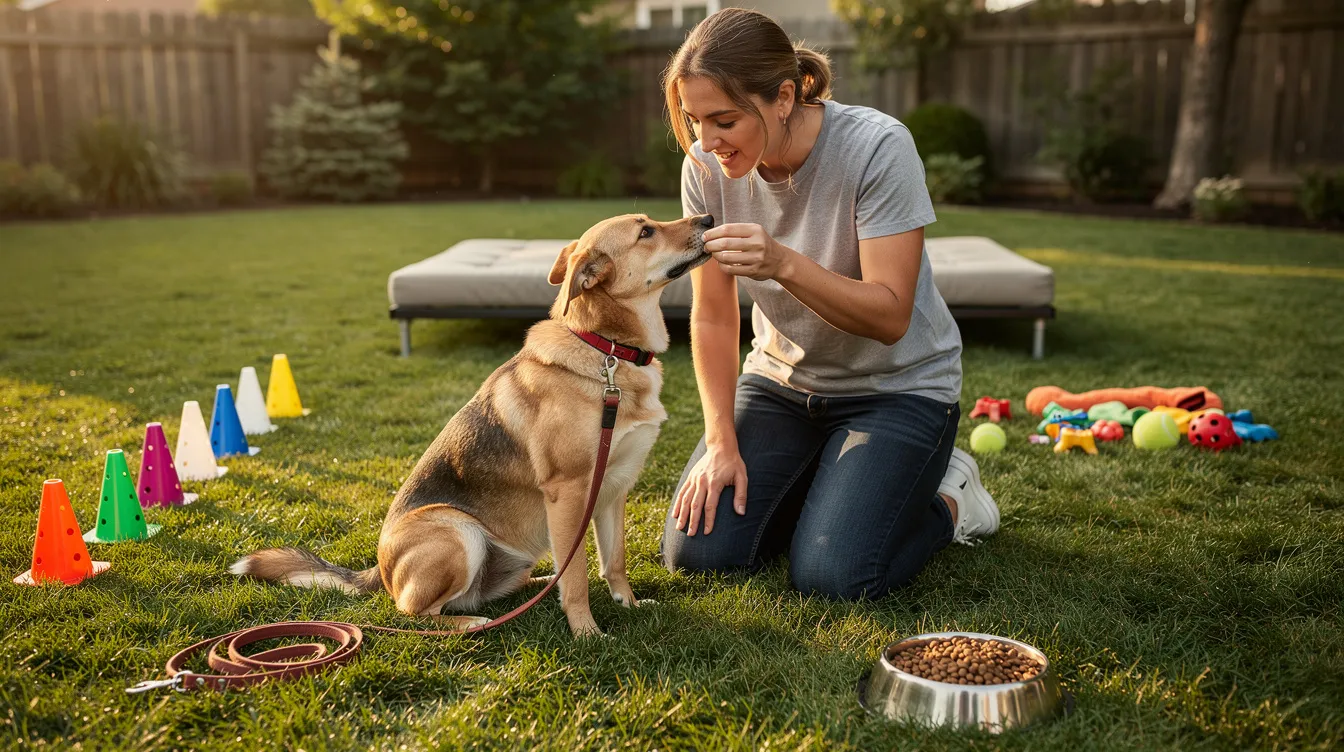
These three starter games teach basic self control before you introduce movement, distance, or high-arousal activities. Each one requires only treats and a few minutes. Short training sessions of about 2 to 5 minutes are effective for teaching impulse control; longer sessions cause most dogs to lose focus.
Hand Zen Game
Sometimes called “It’s Your Choice” or yer choice, this fun game teaches a dog that treats in your hand are unavailable unless you release them.
Hold a low-value treat in a closed fist at your dog’s nose level. Your dog will likely lick, paw, and nudge. Wait. The moment your dog pulls back, even slightly turning its dog’s head away, mark the behavior and reward from your other hand with a higher-value treat.
Once your dog consistently backs off from a closed fist, progress to an open hand. If the dog moves toward the exposed treat, close your fist. When the dog stays patient with an open hand, add a new layer: place treats on your knee, then ask for eye contact before delivering the reward from one hand. Hand Zen teaches dogs that human hands holding food are not an invitation to grab. Using treats this way helps teach dogs self-control effectively.
This approach pairs well with hand feeding practices that build trust around food delivery.
Slow Treat Exercise
The Slow Treat game teaches dogs to wait for food approaching their dog’s mouth without lunging.
Lower a treat toward your dog slowly. If the dog jumps or pushes forward, withdraw the treat and pause. When the dog holds still and allows the treat to reach its dog’s nose calmly, deliver it. No verbal cue is needed at first; the game itself teaches the behavior.
As your dog learns, vary the angle. Start by lowering treats from above the dog’s head, then move to horizontal approaches, then from below. The Slow Treat exercise teaches dogs to wait for food regardless of how it arrives. Gradually increase difficulty by adding slight pauses mid-delivery.
Floor Zen Training
Floor Zen builds on the same idea but puts treats on the ground, where most dogs find them harder to resist.
Place a low-value treat on the floor and immediately cover it with your hand or foot. Your dog starts sniffing, pawing, and nosing at your hand. Wait until the dog stops trying and looks up at you. That moment of eye contact earns a reward from your other hand (not the covered treat).
Gradually uncover the treat. If the dog moves toward it, cover it again. Once reliable, introduce the cue “leave it.” The ‘Leave it’ game helps dogs learn to ignore distractions and encourages dogs to look away from temptations. Best Friends Animal Society provides a detailed protocol for progressing through each stage.
Advanced Interactive Games
Once your dog can patiently wait around stationary treats, introduce games that combine impulse control with physical movement and higher arousal. Practicing impulse control can involve gradually increasing distractions for the dog, which these exercises do naturally.
Wait at the Door Protocol
Door rushing is one of the most common reasons owners seek impulse control training. The ‘Wait at the Door’ exercise teaches dogs to stay behind thresholds until released.
- Approach the door with your dog on leash. Ask for a sit.
- Reach for the doorknob. If the dog moves, remove your hand and wait for the sit again.
- Open the door one inch. If the dog stays, mark and reward. If the dog breaks, close the door calmly.
- Gradually increase how far the door opens. Only step through when your dog stays in position without moving.
- Use a clear release cue (“OK,” “free,” or “let’s go”) before the dog crosses the threshold.
Apply the same sequence to car doors and crate exits. Effective dog training often relies on a strict release cue to promote good behavior at every doorway. Games like ‘Wait’ teach dogs to control their impulses at doorways, and the same protocol works whether you are leaving for a walk or opening the back door to the yard.
Fetch with Impulse Control
Standard fetch teaches a dog to chase. Controlled fetch teaches a dog to think before chasing.
Ask your dog to sit before you throw the tennis ball. If the dog breaks position before the release cue, pick up the ball and reset. On return, the dog must drop the ball and wait before the next throw. The reward is the game itself; play continues only when the dog follows the sequence.
For dogs with strong retrieve drives (sporting breeds, herding breeds), withholding the ball can create frustration. In those cases, use a trade-up toy or high-value treat to reward the drop, then release for the next throw. Games like “Controlled Fetch” teach impulse control to dogs by turning their favorite activity into a self control exercise.
Flirt Pole Training
A flirt pole is a lure attached to a rope on a stick. It triggers chase and prey drive, making it an ideal tool for practicing impulse control under high arousal. Using a flirt pole improves dogs’ impulse control and recall simultaneously.
The game works like this: drag the lure along the ground and let your dog chase. At random intervals, freeze the pole and ask for a sit or down position. The dog must hold that position until you give the release cue, then the chase resumes.
Safety rules for flirt pole play:
- Keep the lure low to the ground to protect joints, especially for puppies
- Limit sessions to 3 to 5 minute bursts
- Avoid hard stops that could cause a dog to twist or skid
- End each round with a sit or down, not during peak excitement
This is a great game for high-energy dogs because it burns physical energy while demanding mental control. For more on matching play styles to your dog’s needs, explore how different activities serve different training goals.
Specialized Training Techniques
These methods address specific household situations and multi-dog dynamics where impulse control training requires more structure.
Multi-Dog Impulse Control
Feeding time in a multi-dog household is a natural training opportunity. Use a dinner time down-stay protocol: all dogs must lie down and stay while you prepare food. Feed one dog at a time. The others hold their down position until released individually. Food bowl patience teaches dogs to wait for permission to eat from their bowl, and practicing this with other dogs watching reinforces the skill under social pressure.
If dogs cannot hold position near each other, use barriers or crates during the learning phase. Rotate which dog eats first to prevent pattern-based anticipation. Individual attention training follows the same rotation principle: work with one dog on obedience while others watch quietly in a designated spot, then switch.
Food-Based Control Games
The bowl preparation waiting exercise teaches dogs that seeing food preparation does not mean immediate access. Ask for a sit or down. Fill the bowl. Place it on the ground. Remove your hand. Only cue “eat” when the dog stays in position. If the dog moves, pick up the bowl and restart.
The treat pouch “find it” game adds a mental challenge: scatter kibble across the ground or room, but require a wait before giving the release cue to search. This builds delay tolerance while engaging the dog’s nose. Consistency with commands is critical for helping dogs learn impulse control skills across all food-related scenarios.
Play-Based Control Methods
You can build impulse control into any play routine without adding separate training sessions. Tug games can be structured to include pauses and rewards for self-control; the dog must drop the toy on cue before the game resumes. Chase games require a recall before the dog earns another round. Hide and seek starts with a stay until the person hides, and the reward is finding the owner.
| Game Type | Control Element | Reward Method | Difficulty Level |
|---|---|---|---|
| Tug of War | Drop on cue | Resume play | Intermediate |
| Chase Games | Recall control | Tug reward | Advanced |
| Hide and Seek | Stay until released | Finding owner | Beginner |
| Agility Play | Wait at obstacles | Forward movement | Advanced |
The Bucket Game deserves separate mention. Originally developed for cooperative care, the Bucket Game helps dogs communicate their comfort with handling by choosing to look at a bucket (opt in) or look away (opt out). It teaches the dog that it controls the pace, which builds both impulse control and trust during grooming, vet visits, or nail trims. The Bucket Game helps dogs opt in to handling on their own terms.
Common Challenges and Solutions
Three problems come up repeatedly when owners begin impulse control games. Each has a concrete fix.
Dog Won’t Release Treats or Toys
When a dog struggles to drop a toy or release a treat, the issue is almost always value mismatch. Offer something better. If the dog has a tennis ball, present a piece of chicken. If a chew toy is in play, use a squeaky toy the dog rarely sees. Time your reward marker at the exact moment the dog’s mouth opens; even a half-second delay teaches the wrong lesson.
Inconsistent Results Between Family Members
If one person uses “leave it” and another says “don’t touch,” the dog is left guessing. Every household member needs to use identical cue words, identical criteria for success, and identical reward timing. Record a short video of one person running through the exercise correctly, then have others watch and practice. This solves most coordination problems within a week.
High-Energy Dogs Struggling with Self-Control
A dog that cannot hold a sit for two seconds needs physical output before a training session, not longer sessions. A 15-minute sniff walk or 10 minutes of free play reduces baseline arousal enough for the dog to think. Games that reward calm behavior are useful for managing over-arousal in dogs, but only if the dog starts the session below its excitement threshold.
Keep sessions short. For puppies, 2 minutes is enough. For adult dogs, 5 to 7 minutes per session. Run multiple short sessions throughout the day rather than one long block. Practicing impulse control games takes just a few minutes weekly to produce visible changes. Starting training early gives puppies a head start on these skills.
A 2025 study on delayed gratification found that dogs with high hyperactivity/inattention scores and only basic training had shorter maximum delay times. Dogs with advanced training showed less impact from those traits, which suggests that consistent, progressed impulse control training buffers against innate impulsivity.
Conclusion and Next Steps
Impulse control games work because they give dogs thousands of repetitions of a simple sequence: want something, wait, get it. Over time, waiting becomes the default rather than the exception. Impulse control helps dogs make better decisions across every part of daily life, from leash walks to mealtimes to greeting visitors.
Impulse control training can be practiced in various environments, which matters because self-control learned in the kitchen does not automatically transfer to the front door or the park. Train each game in multiple locations.
Start here:
- Pick two foundation games (Hand Zen and Floor Zen are the easiest entry points) and practice for 5 minutes daily
- Once your dog can wait reliably in a quiet room, add one advanced game per week
- Track what your dog can do each week: how long the dog stays before a release cue, how many distractions it can ignore, whether it holds position at doors
When you are ready to move beyond home practice, structured obedience training builds on these foundations with proofing under real-world distractions. For owners in the Albany, NY area working toward reliable off-leash obedience, impulse control games are the prerequisite that makes advanced training possible.