
Introduction
Redirected aggression occurs when a dog becomes highly aroused or aggressive toward one trigger but directs that aggression toward another nearby person or animal. This can happen when the dog cannot reach the original trigger, such as another dog behind a fence or an animal outside a window, or when someone intervenes during an intense interaction.
This aggressive response can catch Albany dog owners off guard because the person or animal being targeted may have had nothing to do with the original trigger. What looks like a sudden or random reaction usually makes more sense when you examine what happened immediately before the incident.
This guide covers how to identify redirected aggression, understand factors that can contribute to it, recognize situations where it may occur, and implement practical prevention and management strategies. It does not replace professional behavioral or veterinary assessment, especially for dogs with severe, sudden, or escalating aggression. Whether you’re managing a reactive dog or navigating the complexities of multiple dogs under one roof, this resource is designed to help you understand the behavior and take meaningful action.
The core concept is straightforward: redirected aggression occurs when a dog is highly aroused or aggressive toward one stimulus but redirects the aggressive response toward another person or animal nearby.
By reading this guide, you will:
- Recognize body language that may indicate increasing arousal
- Understand common triggers and high-risk situations
- Implement environmental management and training strategies that may reduce the risk of future incidents
- Know when professional or veterinary help may be appropriate
- Establish practical safety protocols for your household
Understanding Redirected Aggression Fundamentals
Redirected aggression is one of the more confusing forms of canine aggression because the target of the aggressive behavior may not be the stimulus that originally triggered the dog. Unlike resource guarding or territorial aggression, where the response is directed toward the immediate trigger, redirected aggression shifts toward another person or animal nearby.
Understanding this distinction is important because identifying what happened immediately before an incident can help owners manage the environment more effectively and reduce the risk of repetition.
What Redirected Aggression Actually Is
Redirected aggression occurs when a dog is highly aroused or aggressive toward one target but directs the response toward another person or animal nearby. This may happen when the dog cannot reach the original target or when someone attempts to intervene during an intense interaction.
Fear, frustration, conflict, or other forms of heightened arousal may contribute to these incidents, but frustration is not required for redirected aggression to occur.
Think of it this way: a dog sees another dog through a window and becomes highly aroused. The glass prevents direct interaction, and the dog begins barking, lunging, or stiffening. If a family member approaches and attempts to physically interrupt the dog, the aggressive response may be redirected toward that person.
The behavior is not evidence that the dog is “mean,” but it does indicate a potentially dangerous situation that requires careful management.
How It Differs From Direct Aggression
Direct aggression is aimed at the immediate source of the dog’s response. If a dog growls when another dog approaches its food bowl, that may be resource guarding. If a dog reacts defensively toward someone it perceives as threatening, the aggression is directed at that specific individual.
Redirected aggression is different because the target receiving the aggressive behavior was not the original trigger.
This distinction matters for management and training. Correcting the dog after a redirected aggression incident does not identify or remove the original trigger and may add additional stress to an already intense situation.
Understanding why dogs react to other dogs on walks can also help owners distinguish ordinary leash reactivity from situations where aggressive behavior actually shifts toward another target.
The Emotional State Behind Redirection
Redirected aggression can occur during periods of intense emotional arousal. A dog may become highly focused on another dog, person, animal, or environmental event and have difficulty disengaging from that stimulus.
Observable changes may include rigid posture, intense staring, escalating vocalization, lunging, or repeated attempts to reach the trigger. However, individual dogs vary considerably, and there is no single emotional state or sequence of body language that predicts every redirected aggression incident.
Canine reactivity itself is also complex. Dogs may react because of fear, frustration, excitement, uncertainty, or combinations of these factors. Frustration can contribute to redirected aggression when access to something is blocked, but it should not automatically be assumed to be the cause of every incident.
Pain, illness, neurological disease, and other medical conditions can also contribute to changes in aggressive behavior. If aggression appears suddenly, becomes more severe, or occurs without an obvious behavioral pattern, veterinary evaluation is important to help rule out underlying medical factors.
With these fundamentals in place, recognizing situations where redirected aggression may occur becomes much more practical.
Common Triggers and High-Risk Scenarios
Redirected aggression can occur in many everyday situations. Albany dog owners may encounter these situations at home, during neighborhood walks, in vehicles, or in multi-dog households.
Barrier Frustration Incidents
Barrier frustration is one situation in which redirected aggression can occur. A fence, window, leash, crate, or other physical restriction may prevent a highly aroused dog from reaching the original stimulus, increasing the possibility that aggressive behavior is redirected toward another nearby person or animal.
Window reactivity can create this type of situation. A dog watching pedestrians, delivery vehicles, wildlife, or other dogs through a front window may become increasingly aroused. If someone approaches or attempts to physically move the dog during that moment, redirected aggression may occur.
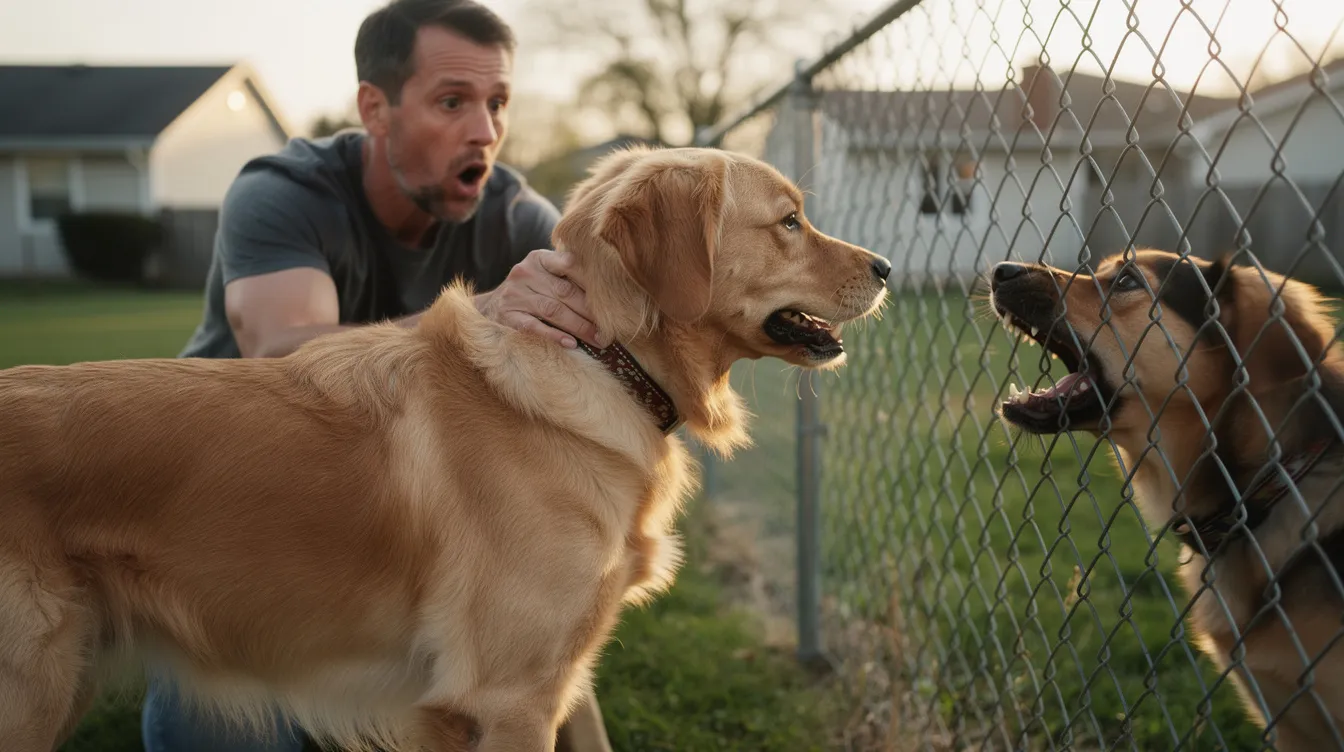
Fence-line aggression can create similar conditions. Dogs running along opposite sides of a fence may bark, lunge, or become increasingly aroused. If another household dog or person moves close during the interaction, the aggressive response may shift toward them.
Vehicle barriers can also restrict a dog’s movement. A dog inside a vehicle may react strongly to another dog, cyclist, jogger, or animal outside. Passengers should avoid unnecessary physical intervention when the dog is highly aroused.
Blocking or reducing visual access to predictable triggers with appropriate window coverings, fencing, or secure travel setups can help limit repeated exposure.
Leash Reactivity Situations
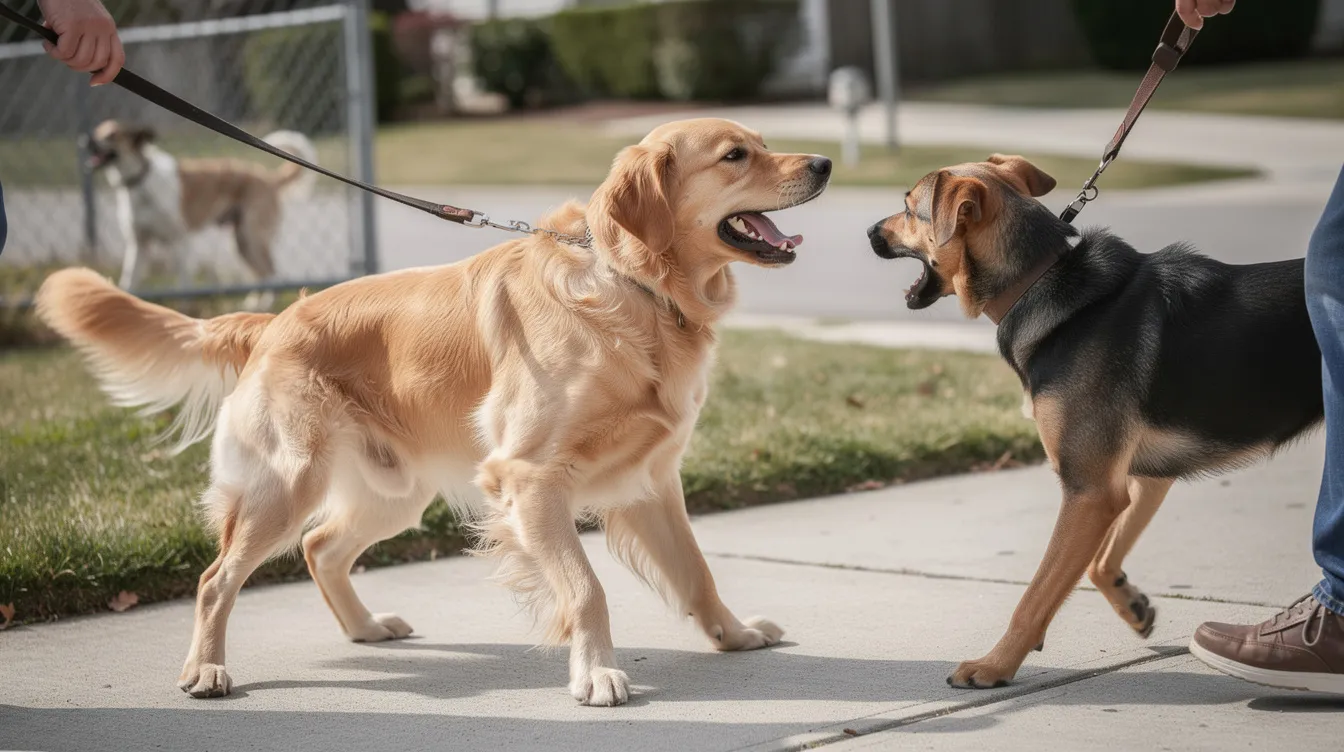
On-leash encounters can create conditions in which redirected aggression occurs, particularly when a dog becomes intensely aroused by another dog, person, or animal and cannot reach or move away from the stimulus.
In some situations, a dog may redirect toward the handler when the handler physically intervenes or restrains the dog. However, leash reactivity does not automatically mean redirected aggression.
Dogs can bark, lunge, pull, freeze, or vocalize on leash for different reasons, including fear, frustration, excitement, uncertainty, or learned behavior. Understanding what dog reactivity on walks actually looks like can help owners recognize these differences.
Restraint during veterinary visits, grooming appointments, or other handling situations may also increase arousal in some dogs. Careful handling and attention to the dog’s body language are particularly important when aggressive behavior has occurred previously.
Multi-Dog Household Dynamics
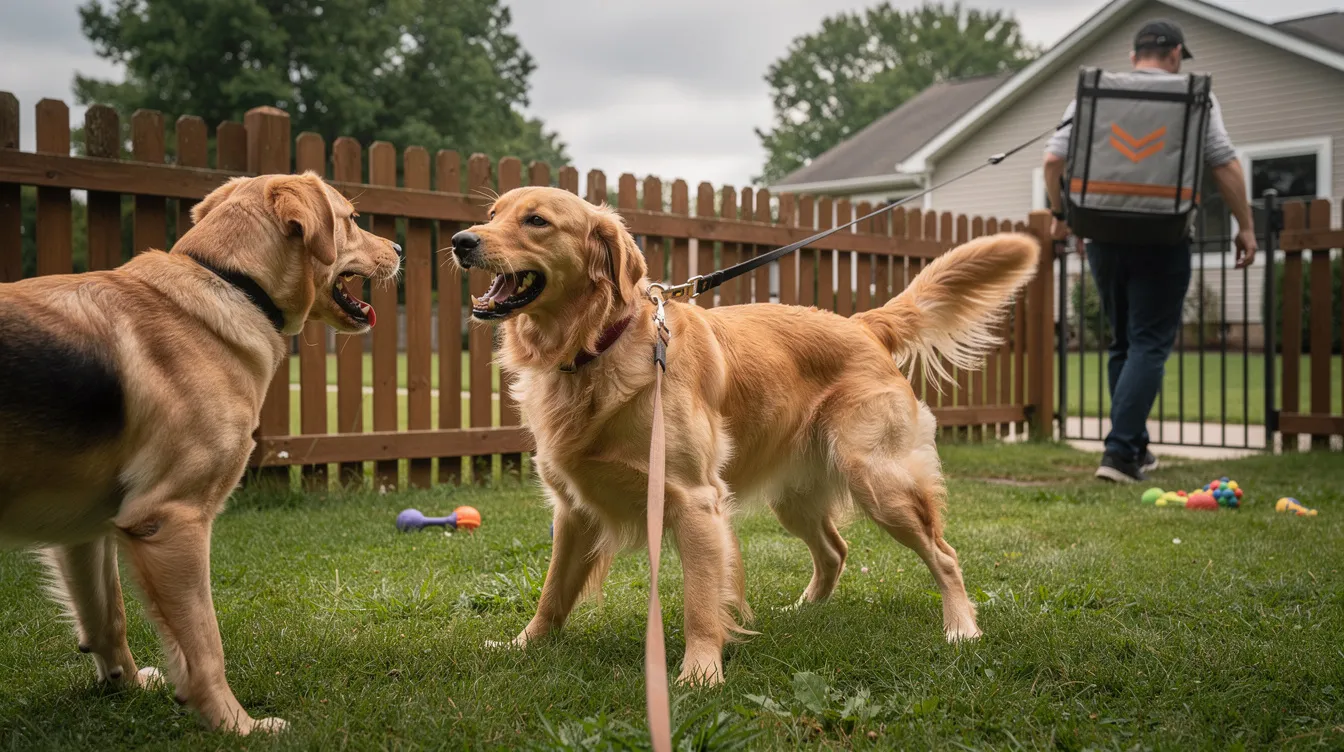
Multi-dog households can present additional risks because one highly aroused dog may redirect toward another dog nearby.
For example, two dogs may become excited by another animal outside a window or activity at the front door. One dog may suddenly turn toward the other, causing the second dog to respond defensively.
However, aggression involving food, toys, sleeping areas, owners, or other valued resources may instead involve resource guarding or another form of inter-dog aggression. Identifying what happened immediately before the incident is essential for understanding the behavior accurately.
If dogs are already fighting, avoid placing your hands between them or reaching near their heads. People who attempt to physically interrupt dog fights can become targets of redirected bites.
Recognizing these situations is the first step. The next is building practical strategies to reduce the chance of escalation.
Recognition and Prevention Strategies
Effective management starts with understanding your individual dog’s behavior and reducing exposure to situations that repeatedly lead to intense arousal.
Early Warning Signs and Body Language
Learning your dog’s individual body language can help you recognize increasing arousal before an incident occurs. Warning signs vary between dogs and situations, and there is no universal sequence that reliably predicts redirected aggression.
Possible physical signs of rising arousal include:
- Stiff or rigid posture
- Weight shifting forward
- Raised hackles
- Intense focus or fixed staring
- Changes in breathing
- Changes in ear position
- Sudden freezing or reduced movement
Raised hackles alone do not mean a dog is about to become aggressive. They indicate arousal and should be interpreted alongside the dog’s other behaviors and the surrounding situation.
Behavioral changes to watch for include:
- Increasing fixation on a trigger
- Difficulty responding to familiar cues
- Escalating barking, whining, growling, or snarling
- Lunging or pulling with increasing intensity
- Repeated attempts to reach or move away from a stimulus
Environmental factors to consider include:
- Close proximity to known triggers
- Fence lines, windows, narrow sidewalks, or other restricted spaces
- Several exciting or stressful events occurring close together
- Situations where the dog has redirected previously
The important factor is recognizing changes early. Once a dog is highly aroused, familiar cues may become more difficult to perform. Creating additional distance before the situation intensifies is often safer than waiting for peak arousal.
Environmental Management Techniques
Environmental management is often one of the first steps in reducing opportunities for redirected aggression.
Visual barrier strategies: Consider frosted window film, curtains, strategic furniture placement, or secure fencing when predictable outdoor activity repeatedly triggers intense reactions. In vehicles, appropriately secured crates or window coverings may reduce visual exposure for some dogs.
Structured activity and enrichment: Appropriate physical exercise, mental enrichment, and predictable routines can support overall behavioral wellbeing. Walks, play, sniffing opportunities, and training exercises can all be useful components of a balanced routine, but exercise alone should not be considered treatment for redirected aggression.
Safe space creation: Some dogs benefit from having a quiet area away from windows, doors, visitors, or other predictable triggers. A crate, gated room, mat, or designated resting area may help create separation when needed.
Teaching the place command can also give owners a structured obedience skill for appropriate situations. However, a place cue should not be relied upon as the only safety measure for a dog that is already highly aroused or aggressive.
Training and Behavior Modification Approaches
Training should be layered on top of effective management rather than used as a substitute for safety precautions.
The appropriate approach depends on the dog’s triggers, history, severity of aggression, and ability to remain responsive around those triggers.
| Method | Purpose | General Application |
| Focus and Impulse-Control Exercises | Build responsiveness and frustration tolerance | Practice skills such as wait, leave it, and attention cues in controlled environments |
| Counter-Conditioning | Change emotional associations with a specific trigger | Pair controlled exposure with something the dog values while remaining at a manageable intensity |
| Desensitization | Increase tolerance of identifiable triggers | Begin with low-intensity exposure and progress gradually |
| Emergency U-Turn | Create distance during walks | Practice changing direction quickly before the dog becomes highly aroused |
Impulse-control and focus exercises can be useful supporting skills, but they should not be treated as a complete solution for aggression.
Counter-conditioning and desensitization may also be appropriate in some cases. These techniques involve carefully controlled exposure rather than forcing a dog into close contact with a trigger.
For dogs with bite histories, severe aggression, or complicated combinations of fear, anxiety, and frustration, professional supervision is especially important.
Owners can also work on reliable recall around distractions as a separate obedience skill, while reactive dog training can help address broader reactivity patterns that may overlap with some redirected aggression scenarios.
Common Challenges and Solutions
Even with careful planning, redirected aggression can be difficult to manage in real-time situations.
Managing Sudden High-Arousal Episodes
When a dog is already highly aroused or actively aggressive, prioritize creating safe distance without placing your hands near the dog’s head or stepping directly into a conflict.
If a practiced cue such as an emergency U-turn or “this way” works before escalation, use it to move away from the trigger. Physical barriers such as doors, gates, or other secure separation methods may be safer than attempting to grab the dog directly.
Avoid physical punishment during or after an aggressive episode. Adding confrontation to an already intense situation may increase fear, conflict, or arousal without addressing the original trigger.
If repeated incidents make safe handling difficult, seek professional guidance to develop an individualized management plan.
Handling Multiple-Dog Redirections
In multi-dog households, the priority is reducing opportunities for one dog’s arousal to spread into conflict with another.
Use secure gates, doors, exercise pens, or other appropriate barriers to separate dogs when predictable triggers occur. Leashes may also be useful when handled safely and under supervision.
If food, toys, chews, or other resources create tension, consider managing those items separately until the underlying behavior has been properly evaluated.
Do not step directly between dogs that are actively fighting or place your hands near their mouths. Instead, prioritize safe separation methods that minimize direct physical exposure whenever possible.
Emergency Safety Protocols
Every household member should understand what to do during predictable high-risk situations.
- Doorbell protocol: Use a secure gate, closed room, or reliable trained behavior before opening the door if visitors trigger intense arousal.
- Walking protocol: Maintain enough distance from known triggers and have a practiced direction-change cue.
- Barrier access: Know where secure doors, gates, or other separation options are located.
- Children’s safety: Children should never attempt to intervene in aggressive interactions between dogs. Teach them to move away when it is safe to do so, stay behind a secure barrier, and get an adult.
- Household communication: Make sure family members know the dog’s known triggers and management rules.
The goal of an emergency plan is not to confront the dog. It is to reduce exposure, create safe separation, and prevent people or animals from entering the path of redirected aggression.
Conclusion and Next Steps
Redirected aggression is a recognizable behavioral pattern, not simply a sign that a dog is “bad.” It can occur when a dog becomes highly aroused or aggressive toward one stimulus and redirects that behavior toward another nearby target.
Progress depends on the dog’s triggers, bite history, underlying motivation, environment, medical status, and consistency of management and training. There is no reliable universal timeline for reducing redirected aggression, and expectations should be individualized.
Start with these practical steps:
- Identify your dog’s specific triggers by recording what happens immediately before incidents or major increases in arousal.
- Reduce unnecessary exposure to predictable triggers with appropriate barriers, distance, and household management.
- Practice obedience and focus skills in low-distraction environments before expecting them to work near difficult triggers.
- Avoid punishment and unnecessary physical confrontation during high-arousal situations.
- Seek professional help when aggression involves bites, repeated incidents, escalating intensity, or situations you cannot manage safely.
Professional Training Options for Complex Cases
Albany Off Leash K9 Training currently offers aggression-focused private lessons for dogs struggling with aggression or reactivity, along with a 3-Week Behavioral Modification Board & Train program for dogs dealing with reactivity, aggression, or intense anxiety.
Available options include aggression-focused private lessons and a 3-Week Behavioral Modification Board & Train for more serious behavior cases when that program is appropriate.
Professional help is particularly important if bites have occurred, aggression is becoming more frequent or severe, or you cannot reliably prevent access to known triggers.
Sudden behavioral changes should also be discussed with a veterinarian. When aggression is severe or complicated by possible anxiety, medical concerns, or neurological issues, a Board-Certified Veterinary Behaviorist may be appropriate.
Related topics worth exploring include why dogs react to other dogs on walks and this complete guide to dog aggression for a broader look at aggressive behavior and management.
Frequently Asked Questions
What is redirected aggression in dogs?
Redirected aggression in dogs occurs when a dog is aggressive or highly aroused toward one trigger but directs the aggressive response toward another nearby person or animal. This can happen when the dog cannot reach the original target or when someone intervenes during an intense interaction.
How can I tell if my dog is about to redirect aggression?
There is no universal set of warning signs that predicts every incident. However, increasing stiffness, intense fixation, escalating barking or growling, lunging, freezing, or difficulty disengaging from a trigger can indicate rising arousal and the need for additional distance or management.
Why does redirected aggression happen?
Redirected aggression can occur when a dog is highly aroused or aggressive toward one stimulus and the response shifts toward another nearby target. Fear, frustration, conflict, restricted access to a trigger, or other forms of heightened arousal may contribute depending on the situation.
Is redirected aggression dangerous?
It can be. Redirected aggression may result in bites or fights involving people or animals that were not the original source of the dog’s reaction. The risk is particularly important when someone tries to physically intervene during an active aggressive episode.
How can I prevent redirected aggression in my dog?
Prevention focuses on identifying triggers, reducing unnecessary exposure, creating safe distance, using appropriate physical barriers, and teaching useful obedience and focus skills. Dogs with repeated or severe incidents should receive individualized professional assessment.
Can redirected aggression be treated?
Redirected aggression can often be managed and improved through environmental management, appropriate training, and professional behavior support, but outcomes vary depending on the dog’s triggers, history, severity, and underlying causes. Dogs with bite histories, escalating aggression, or sudden behavioral changes should receive professional assessment.
Does redirected aggression mean my dog is aggressive toward humans?
Not necessarily. A person may become the target of redirected aggression even when the original trigger was another dog or animal. However, any aggression toward people should still be taken seriously and managed with appropriate safety precautions.