Introduction
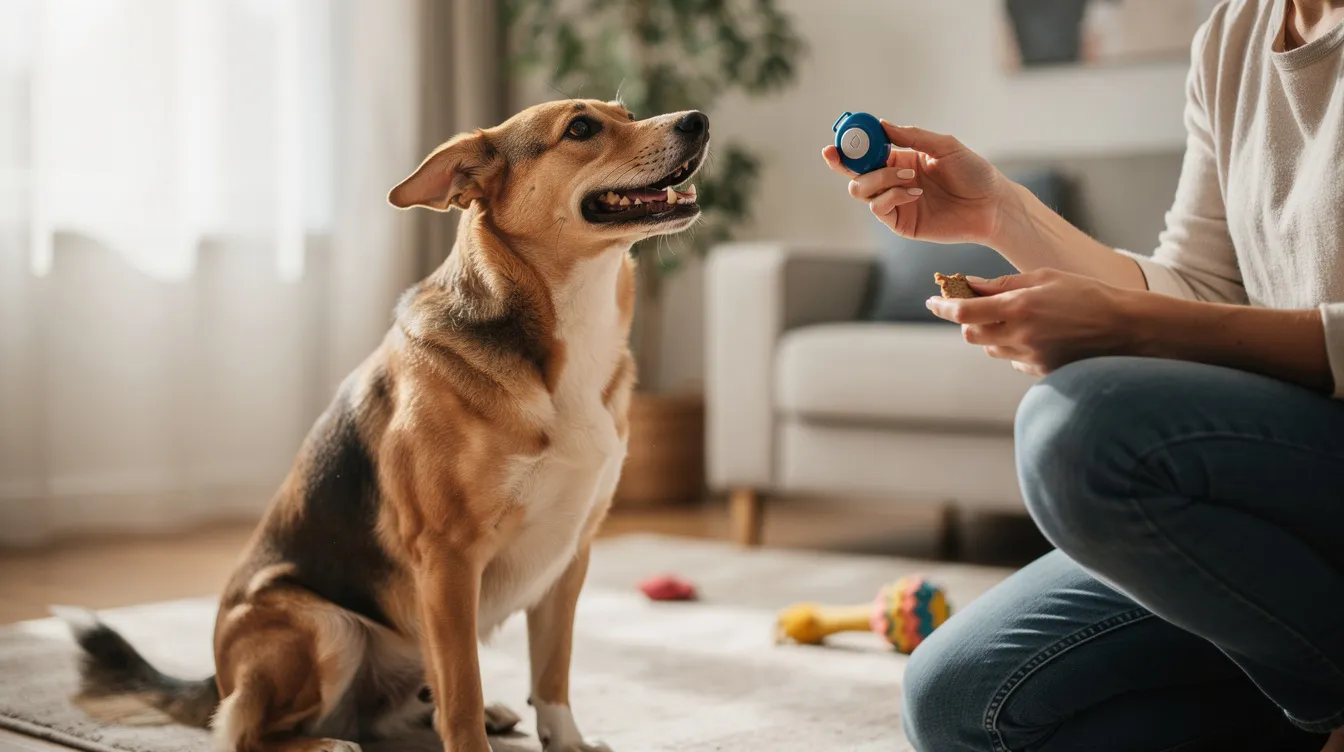
Clicker training creates a precise communication channel between you and your dog by using a small mechanical noisemaker to mark the exact moment a desired behavior occurs. The click acts as a conditioned reinforcer; once the dog associates that same sound with a food reward, it knows exactly which specific behavior earned the treat. This method is grounded in operant conditioning and positive reinforcement, and it produces measurable changes in how quickly dogs acquire new behaviors and how reliably they perform them.
This guide covers the behavioral mechanisms behind clicker training, the specific outcomes it produces, realistic timelines for results, and how it integrates with other dog training methods. The target audience is dog owners in the Albany, NY area who are evaluating training options for puppies, dogs with behavioral issues, or advanced obedience goals.
What clicker training does in a single sentence: it accelerates animal learning by removing ambiguity about which exact behavior is being rewarded, producing faster acquisition, better retention, and reduced stress during training sessions.
After reading this guide, you will understand:
- How the clicker functions as a conditioned reinforcer and why that speeds up learning
- Which specific behaviors clicker training improves and by how much
- Realistic timelines for seeing results across different training goals
- How clicker training compares to traditional methods and balanced approaches
- When clicker training alone is sufficient and when it needs to be combined with other tools
Understanding How Clicker Training Creates Results
Clicker training is a marker-based communication system. The trainer uses a clicker to produce a short, consistent click sound at the precise moment the dog performs a desired behavior. That click bridges the timing gap between the behavior and the food treat that follows, telling the dog “that action you just did is the one I want.” This bridging function is what separates clicker training from methods where the dog has to guess which of several recent actions earned the reward.
For dog owners looking at everything from puppy training to advanced obedience lessons, understanding this mechanism explains why clicker training works across such a wide range of applications.
The Science Behind Behavioral Changes
The clicker starts as a neutral stimulus. Through repeated pairing with a primary reinforcer (usually a food reward), the click becomes a conditioned reinforcer. This process follows the same operant conditioning principles that B.F. Skinner documented in laboratory research, later applied to companion animals by Karen Pryor and other animal trainers. Successful clicker training requires this prior conditioning step to associate the click with a reward; trainers call this “charging the clicker.”
A 2020 meta-analysis of 34 applied animal training studies found that conditioned reinforcement training (clicker + food) produced a mean effect size of Tau-U = 0.77 (95% CI [0.53, 0.89]) compared to baseline behavior. Studies using multiple-baseline designs that taught new behavior averaged an effect size of 0.90, which falls in the medium-to-large range. Neuroscience research suggests that conditioned reinforcers trigger dopamine release, strengthening the neural pathways associated with the marked behavior and improving the dog’s memory of what it did at the exact moment of the click.
Communication Enhancement Effects
The clicker eliminates a common training problem: the dog not knowing which behavior earned the reward. When a trainer says “good boy” while reaching for a treat, the dog may have already shifted position, looked away, or performed other behaviors. The click is instantaneous and distinct. Clicker training helps avoid confusion about rewarded behaviors because the same sound occurs every time, unlike verbal praise, which varies in tone, volume, and timing depending on the person delivering it.
This precision in communication is what makes the learning process faster across all training contexts, from teaching a puppy to sit to shaping complex service dog tasks. Animals learn faster with clicker training due to this clear communication and reduced ambiguity. The practical result is a dog that actively offers wanted behaviors instead of passively waiting for instruction.
With this communication foundation established, the next question is: what specific behaviors does clicker training produce?
Specific Behavioral Outcomes Clicker Training Achieves
The communication clarity described above translates into measurable training results across three categories: basic obedience, complex behavior development, and behavioral modification.
Basic Obedience Acceleration
Clicker training for dogs accelerates acquisition of sit, stay, down, and come commands. The dog learns to associate specific body positions with the click and reward, which reduces the trial-and-error period common in treat training without a marker. Start training with simple commands like “sit” for beginners; most dogs can reliably offer a sit on cue within a few short sessions when using a clicker. Dogs can learn up to 120 unique commands using clicker training, a figure documented by professional dog trainer organizations and used as a benchmark by Guide Dogs for the Blind, which employs clicker training in its programs.
Research findings are worth noting here. A study of 51 naïve dogs divided into three groups (clicker + food, verbal marker + food, food only) found all groups reached criterion at comparable speeds for simple novel behaviors. For basic training tasks, the clicker’s advantage over a well-timed verbal marker or food-only approach can be small. Where clicker training shows its greatest separation from traditional training is in precision and in more complex applications.
Complex Behavior Development
Shaping is the process of breaking a complex behavior into small successive approximations, reinforcing each step until the dog performs the full chain. This is where clicker training produces results that traditional methods struggle to match. A professional dog trainer working on off-leash obedience training uses the clicker to mark precise behaviors at distances where verbal communication becomes unreliable.
Clicker training encourages active participation and problem-solving in animals. Rather than waiting to be lured into position, a clicker-trained dog begins offering behaviors, essentially experimenting to find what earns the click. This is how therapy dog and service dog candidates learn tasks like object discrimination, alert behaviors, and complex retrieval sequences. Clicker training builds confidence in animals by rewarding correct actions, which is particularly important for service dogs that need to perform reliably in unpredictable public environments.
One study found that dogs trained with a clicker took longer to extinguish learned behavior when reinforcement was discontinued, suggesting the clicker strengthens behavior durability. For off-leash reliability, this retention effect matters: the dog reliably performs the behavior even when distance from the trainer increases.
Behavioral Modification Results
Clicker training reduces stress for animals during training sessions, which makes it particularly effective for dogs with fear, anxiety, or aggression issues. In a case study involving four companion dogs with resource guarding, trainers used backward chaining with a clicker to teach the dogs to release guarded items on cue. The dogs showed a measurable reduction in stiffening, staring, and other aggression indicators within several weeks.
Another documented example: a shepherd named Bella with protective aggression walked past a stranger within 8 feet with a relaxed tail after 5 weeks of clicker-based desensitization. By week 10, she could accept a stranger reaching out a hand, and her default behavior shifted to disengagement and looking to the handler. For dog aggression training, these results illustrate how reward-based training with a clicker captures small improvements in threshold, gradually building a new behavioral pattern without escalating fear or arousal.
Clicker training avoids fear or punishment, promoting a stress-free learning environment. It fosters a trusting relationship between handlers and animals by using positive reinforcement rather than prong collars or other aversive tools as the primary teaching mechanism.
Training Efficiency and Timeline Improvements
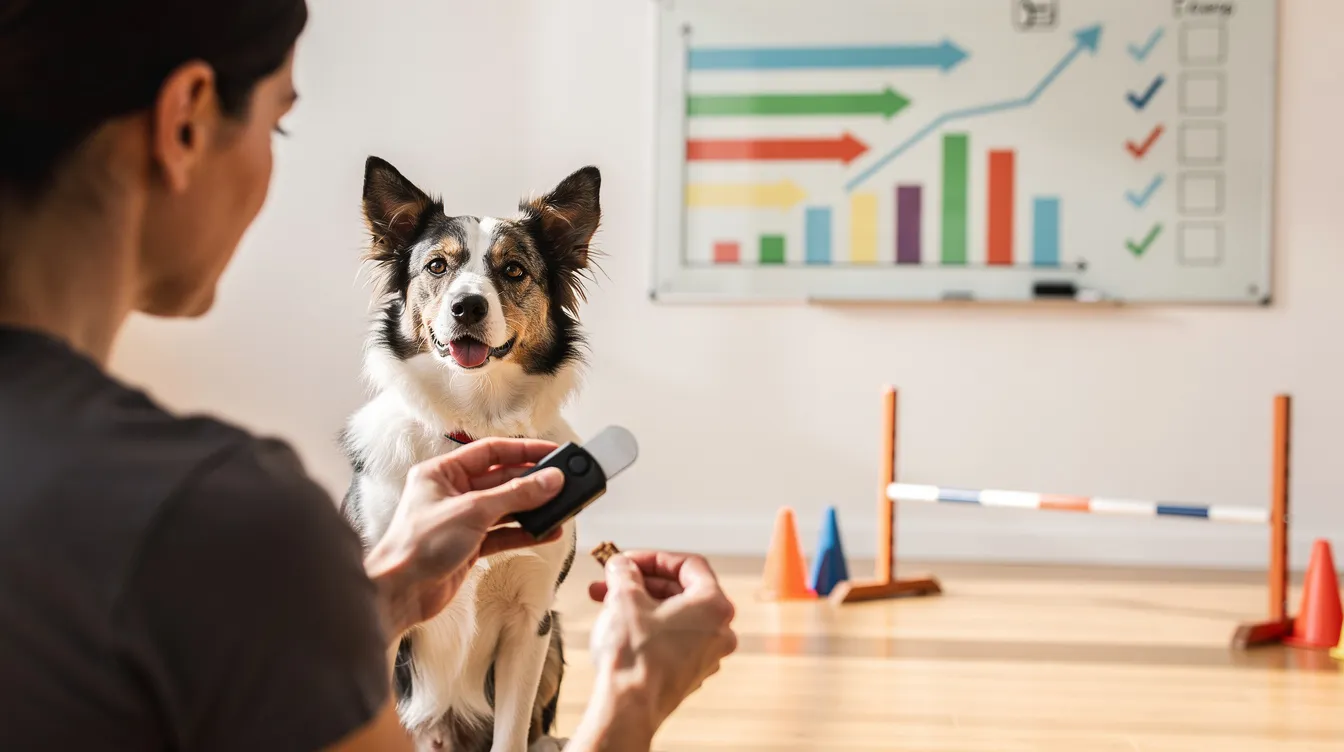
How long does clicker training take to produce results? The answer depends on what you are training, but the data points to faster timelines than most owners expect.
Session Duration Optimization
Clicker training sessions work best when kept short and focused. For reactive or aggressive dogs, initial sessions may last only 30 seconds to 2 minutes due to the intensity of the work. As the dog builds threshold, sessions gradually extend to 3-5 minute exposures. For basic obedience with a puppy, several sessions of 5-10 minutes per day produce faster results than one long training block.
This compressed format has direct benefits for board and train programs. Professional trainers can run multiple short, high-quality sessions throughout the day. Each session has a clear objective, a defined marker for success, and immediate feedback for the dog. The result is more new behavior acquisition per day of training compared to longer, less structured sessions.
A 6-week trick training study found that both clicker + food and food-only groups improved over a control group. The clicker group did not acquire tricks faster than the food-only group in that particular study, but the meta-analytic data across 34 studies show medium-to-large effect sizes for clicker-based interventions. The difference often shows up not in speed of initial learning, but in precision of the learned behavior and retention over time.
Training Method Comparison
| Training Outcome | Clicker Only | Traditional Methods | Balanced with Clicker |
|---|---|---|---|
| Learning Speed | Comparable to food-only for simple tasks; faster for complex shaping | Moderate; relies on timing of verbal praise or hand signal | Fastest for advanced obedience and behavioral modification |
| Behavioral Precision | High; click marks exact behavior | Variable; depends on trainer’s verbal marker consistency | Highest; combines marker precision with additional communication tools |
| Off-leash Reliability | Good; shaped behaviors generalize well | Moderate; often relies on leash pressure | Excellent; e-collar integration provides distance communication |
| Welfare Outcomes | Positive; lower stress and pessimistic bias | Varies with method | Positive when aversive tools are applied correctly under professional guidance |
For Albany area dog owners choosing a training approach, the data suggests that clicker training alone handles basic obedience and puppy training well. For goals like off-leash reliability, behavioral modification, or service/therapy dog preparation, a balanced approach that integrates clicker training with other tools produces the most consistent outcomes.
Common Challenges and Solutions
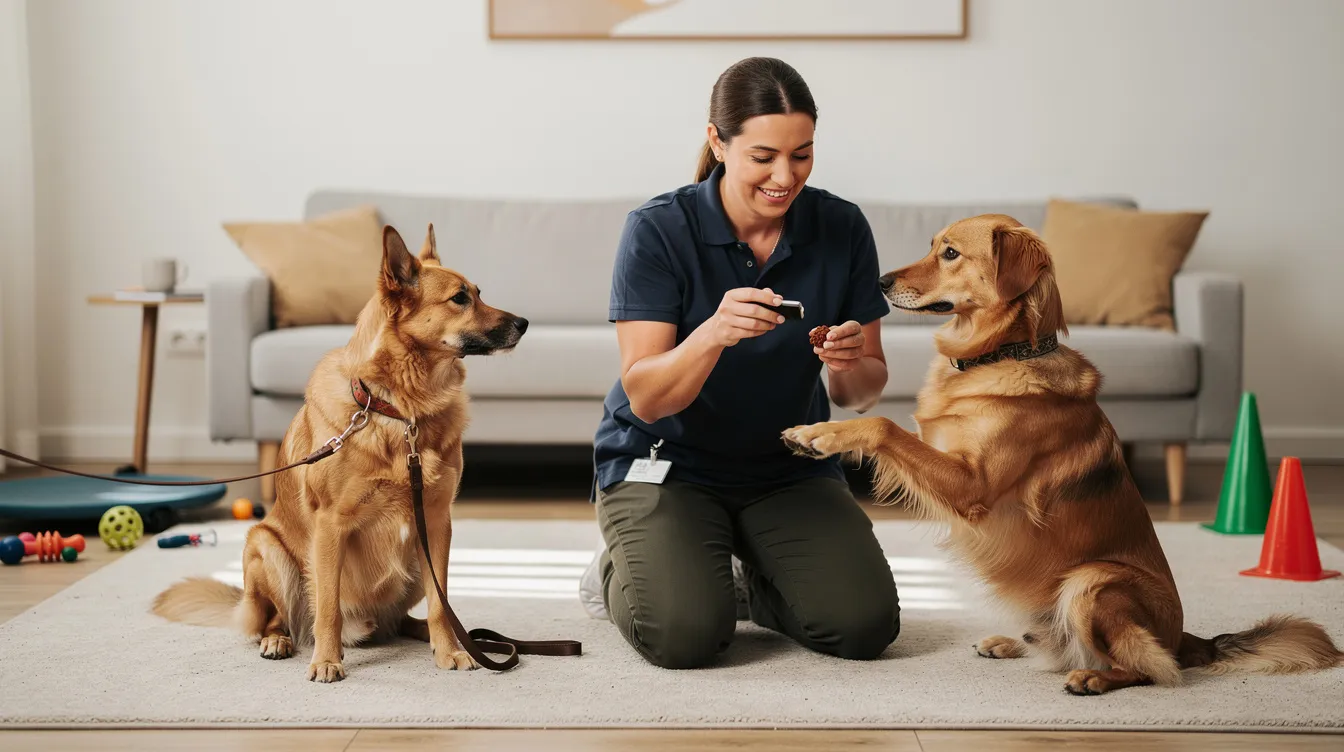
Clicker training produces real results, but three common problems cause owners to plateau or lose momentum.
Inconsistent Results
The most frequent cause of inconsistent results is poor click timing. If the click arrives even one second after the behavior ends, the dog may associate the click with whatever it was doing at that moment rather than the target behavior. Precise timing is non-negotiable. When multiple family members train the same dog, each person must click at the exact moment the desired behavior occurs. A chosen marker only works if everyone uses it the same way. For complex behavioral issues, working with a professional dog trainer ensures the timing and criteria remain consistent.
Plateau in Learning Progress
Plateaus usually mean the dog has mastered the current step, but the trainer hasn’t broken the next step into a small enough approximation. Clicker trainers call this a “criteria problem.” The solution: lower the criteria (accept a smaller version of the behavior), click and reward that, then gradually raise expectations. If a dog has stalled on a recall at 30 feet, go back to 15 feet, rebuild the strong association between the click and the behavior, and then increase distance in small increments. For dogs that need intensive, consistent training to push through plateaus, a board and train program provides the structured repetition that home environments often lack.
Reduced Motivation Over Time
If a dog stops responding to the clicker, the usual cause is that the click has lost its meaning. This happens when trainers click without following up with a food reward, or when they use partial reinforcement schedules too early. Research on reward schedules found that dogs given intermittent rewards during clicker training developed a more pessimistic affective state without any improvement in learning speed. Continuous reinforcement (every click followed by a treat) produces better welfare outcomes and faster learning during the acquisition phase. Transition to variable schedules only after the new behavior is fully established. Integrating play, verbal praise, and real-life rewards alongside the clicker keeps the dog engaged over weeks and months of training.
Conclusion and Next Steps
Clicker training does three things measurably well: it marks the exact behavior you want with a precision that voice alone cannot match, it accelerates learning by reducing the dog’s guesswork, and it produces behaviors that resist extinction better than some alternative methods. The click signals that a reward is on the way, and that simple mechanism produces results ranging from puppy sit commands to the rehabilitation of aggressive dogs. Clicker training can be adapted for various animal species; marine mammal trainers, zoo professionals, and companion animal trainers all use the same underlying principles. Clicker training enhances animal welfare in zoos and aquariums using these same positive reinforcement training techniques.
The data also shows that clicker training is not a magic tool. For simple obedience tasks, it performs comparably to food-only or verbal marker methods. Its greatest advantages appear in complex behavior shaping, behavioral modification, and situations requiring high precision.
Your next steps:
- Assess your current training goals: basic obedience, behavioral issues, or advanced off-leash work
- Charge the clicker by associating it with a reward like treats; 15-20 pairings in a quiet environment before your first real training session
- For behavioral issues like aggression or severe anxiety, consult with a professional before attempting modification on your own
- Evaluate whether a balanced training approach that combines clicker training with other tools fits your specific situation
Related topics worth exploring: how long dog training takes for different goals, e-collar training integration for off-leash reliability, and trick training as a way to strengthen the clicker foundation while building your dog’s problem-solving skills.
Frequently Asked Questions
How long does it take to see results from clicker training?
For basic obedience commands like sit or down, most dogs show reliable responses within several sessions spread over a few days. Behavioral modification takes longer. In the resource guarding study, four dogs showed a measurable reduction in aggressive indicators within several weeks. For reactive aggression, the Bella case documented relaxed behavior around strangers at 5 weeks and neutral acceptance of approach by week 10. How long training takes depends on the behavior’s complexity and the dog’s history.
Can clicker training work for aggressive dogs?
Yes, with professional guidance. In a documented case, a Golden Retriever named Ben with aggression began accepting treats after two months of clicker-based threshold work. Over the following months, the trainer used the clicker to teach incompatible behaviors (looking at the handler instead of reacting to triggers). Clicker training works for aggression because it captures small improvements without escalating arousal, but severe aggression cases require a professional dog trainer who can manage safety and integrate desensitization protocols.
Should clicker training be used alone or with other methods?
Research supports combining the clicker with other tools for the best results. Clicker training uses positive reinforcement to teach behaviors, but for goals like off-leash reliability at distance or behavioral modification in high-distraction environments, integrating e-collar communication or environmental management produces more reliable outcomes. The clicker teaches the dog what to do; other tools help maintain that behavior across real life contexts.
Is clicker training suitable for all dog ages and breeds?
Clicker training can be used across various animal species, including deaf animals (using a light flash instead of click sounds as the reward marker). Puppies often adopt the marker association quickly. Training older dogs or senior dogs requires a slower conditioning phase because they may have existing associations with other training cues. Breed drive affects which primary reinforcer works best (high-drive working breeds may need a higher-value food treat or toy reward), but the clicker mechanism itself functions across all breeds.
How does clicker training fit into board and train programs?
In a board and train setting, professional trainers use the clicker consistently across multiple daily sessions, maintaining the same criteria and timing that home training often lacks. The clicker accelerates the rate of learning during the intensive training window (typically two to three weeks), and the strong association between click and reward transfers to the owner during the handoff session. Owners learn to click the clicker with the same timing the trainer used, so the dog’s learned behaviors carry over to the home environment.