
Introduction
Dog reactivity is a heightened emotional response to specific triggers that causes a dog to overreact with barking, lunging, growling, or other intense behaviors. Understanding the distinct types of reactivity your dog exhibits is the single most important step toward choosing the right training plan and seeing real progress.
This guide covers the seven main types of dog reactivity, their underlying causes, and how they differ in terms of training difficulty. It is written for dog owners who are dealing with reactive behavior and need to pinpoint exactly what is driving their dog’s reactions-whether that’s other dogs on a walk, noises during a thunderstorm, or strangers entering the home. Identifying the specific type matters because a leash-reactive dog driven by frustration requires a fundamentally different approach than a sound-sensitive dog driven by fear.
The main types of dog reactivity include leash reactivity, barrier reactivity, visitor reactivity, sound sensitivity, motion reactivity, resource guarding reactivity, and social reactivity. Each type has unique triggers, body language patterns, and behavioral profiles that shape the ideal intervention strategy.
By the end of this article, you will be able to:
- Identify which type (or types) of reactivity your dog displays
- Distinguish between fear-based and frustration-based reactive behavior
- Understand which types of reactivity typically respond fastest to training
- Recognize when professional help or veterinary behaviorist support is necessary
- Take immediate, informed steps toward a customized behavior modification plan
Understanding Dog Reactivity Fundamentals
Dog reactivity refers to an intense, often immediate behavioral response toward a stimulus-another dog, a person, an object, a noise, or movement-that exceeds what is typical or proportional for the situation. Reactivity does not always indicate a desire to cause harm. Reactivity differs from aggression, which intends to threaten or harm. Many reactive dogs are fearful, frustrated, or overly aroused rather than genuinely aggressive. Recognizing the trigger and body language helps determine the type of reactivity, which is essential before starting any training.
Identifying dog reactivity requires observing shifts in posture and body language. Reactivity can manifest through barking, lunging, or growling, but also through subtler stress signals like stiff posture, raised hackles, intense staring, or freezing in place. Keeping a trigger diary can reveal patterns in a dog’s reactivity-documenting when, where, and what causes the dog to react helps build a clear picture of the problem.
Fear-Based vs. Frustration-Based Reactivity
Distinguishing fear from frustration is essential for effective training, because these two motivations produce different behaviors and require different interventions.
Fear-based reactivity arises when a dog perceives a threat. Fear-based signs include cowering, tucked tails, and stiff postures. The dog’s emotional response is defensive-it wants the trigger to go away. Common triggers include strangers, sudden noises, and novel objects. Fearful dogs often react due to past trauma, lack of socialization during puppyhood, or genetic predisposition. Fear-based reactivity often leads to defensive aggression in dogs if the perceived threat doesn’t retreat, making it critical to address early.
Frustration-based reactivity occurs when dogs are restrained or blocked from reaching something they want-a dog to greet, a squirrel to chase, or space to explore. Frustration from being restrained can cause leash reactivity, fence-line charging, and escalating vocal outbursts. The dog’s brain activates distinct neural circuits compared to fear; research has identified areas like the anterior insula and midcingulate cortex involved in frustration non-reward responses. The body language is typically more forward-leaning, with high arousal and whining mixed with barking, rather than the retreat-oriented posture of a fearful dog.
Trigger-Specific vs. Generalized Reactivity
Some dogs have narrow, specific triggers-they may only react to men with beards, children running, or the sight of another dog at close range. Others display reactive behavior across multiple categories: people, noises, motion, and unfamiliar environments. Triggers can vary by dog and context, like crowded spaces versus quiet streets.
Research from the University of Lincoln shows that dogs reacting to multiple triggers beyond other dogs are significantly more likely to fall into high-risk behavioral clusters with greater escalation potential. Generalized reactivity often indicates deeper-rooted anxiety or chronic stress, requiring comprehensive behavior modification rather than simple trigger management. Dogs can exhibit multiple types of reactivity simultaneously, which makes professional assessment particularly valuable.
Understanding these foundational distinctions-fear versus frustration, specific versus generalized-equips you to accurately classify what you see in the seven main types of reactivity that follow.
The Seven Main Types of Dog Reactivity
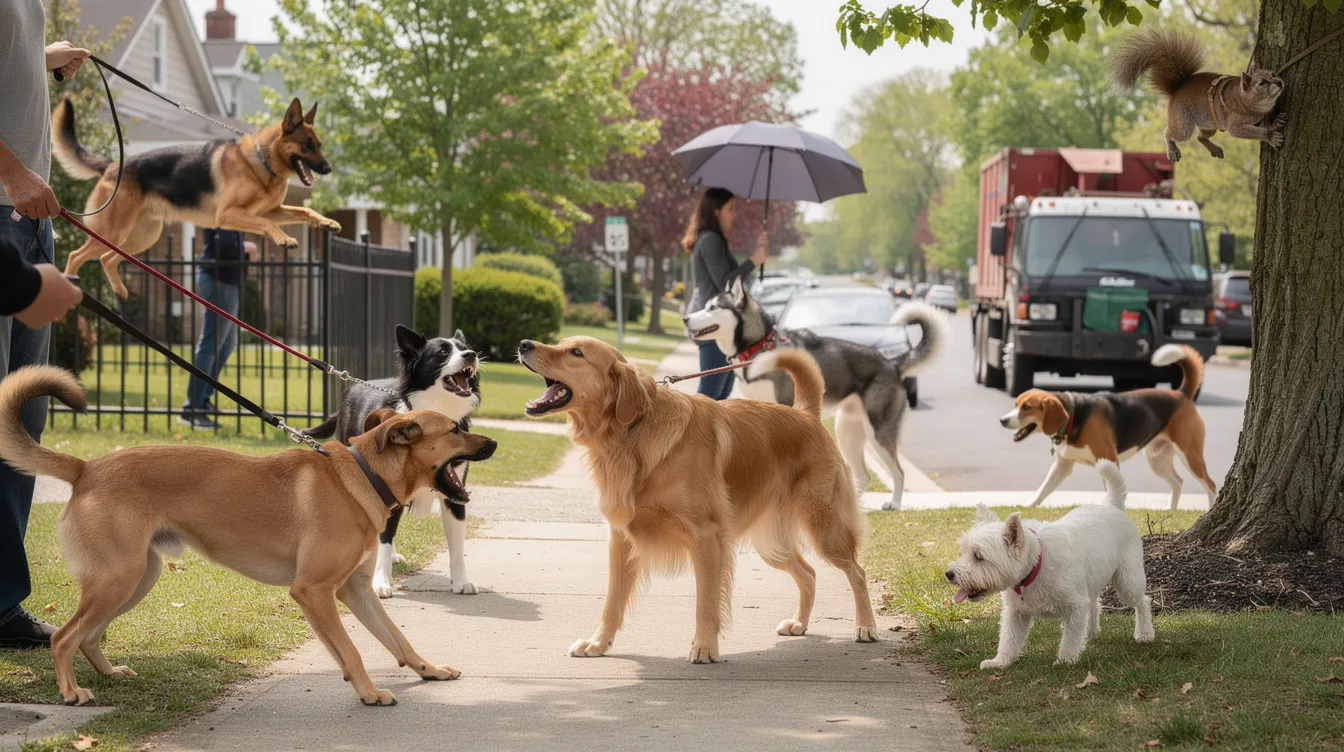
These seven types represent the most common reactive behaviors seen in dogs across Albany and surrounding areas. While the categories are distinct, remember that many reactive dogs display more than one type. Common triggers include other dogs, people, and specific situations, and each type has its own behavioral signature.
Leash Reactivity
Leash reactivity is one of the most frequently reported types of reactivity. Leash-reactive dogs may bark, lunge, or whine at triggers-typically other dogs, people, cyclists, or joggers-while on leash. The core mechanism is “barrier frustration”: the leash prevents the dog from doing what it wants (approaching, retreating, or investigating), and that blocked goal creates intense arousal.
Some dogs react only on-leash but are fine off-leash. A dog that lunges and dogs bark wildly at a passing dog during a walk may be perfectly social at a dog park when off leash. This contrast is a hallmark of frustration-driven leash reactivity. Leash reactivity often stems from frustration or fear, and common breeds prone to it include terriers and German Shepherds. Leash reactivity can be exacerbated by lack of socialization during critical developmental windows.
On-leash reactivity can differ significantly from off-leash behavior, which is why professional evaluation matters. A dog that exhibits calm behavior when free to choose its own distance may need targeted leash-specific training rather than broad socialization work.
Barrier Reactivity (Fence/Window)
Barrier reactivity occurs when a dog reacts to stimuli from behind a physical barrier-a fence, window, screen door, or gate. Behaviors include fence-running, window charging, and intense barking at people or animals passing by. This is sometimes called “fence-fighting” when two dogs on opposite sides of a fence escalate each other.
Territorial reactivity is triggered when a dog feels their space is invaded, and barriers create a clear boundary line that dogs often feel compelled to defend. Motion outside the barrier-squirrels, pedestrians, delivery trucks-amplifies the response. The good news is that barrier reactivity often improves quickly with proper management strategies: covering windows, installing opaque fence panels, and limiting the dog’s access to high-trigger barrier zones. The Wisconsin Humane Society recommends combining environmental management with counter conditioning to gradually decrease reactive outbursts at barriers.
Visitor Reactivity
Visitor reactivity involves reactive moments when people enter the home or territory. The dog may bark explosively at the door, lunge through a gate, hide in another room, or display aggressive reactivity toward guests. The motivation can be territorial protection (defensive aggression) or social fear-and distinguishing between these two requires careful observation of the dog’s body language.
A dog that charges the door with a stiff body, direct stare, and growling is displaying territorial defense. A dog that barks but retreats, shows whale eye, or hides behind furniture is more likely fear-driven. Both stem from insufficient socialization during puppyhood, but fear-based visitor reactivity tends to require more gradual exposure work. Management strategies include using baby gates or teaching a reliable place command to give the dog a structured alternative during arrivals, combined with visitor protocols like ignoring the dog until calm behavior appears.
Environmental and Sensory Reactivity Types
Beyond social triggers, many dogs react intensely to environmental factors-sounds, movement, or perceived threats to valued resources. These types of reactivity often have strong genetic components and may require different training approaches than socially-driven reactions.
Sound Sensitivity
Sound sensitivity-or noise reactivity-is among the most prevalent forms of reactivity in dogs. A major Swedish survey found that approximately 23% of dogs showed a strong fear response to fireworks, with smaller but significant percentages reacting to thunder (~10%) and gunshots (~14%). Nearly half of owners reported some degree of noise-related fear or anxiety in their dogs.
Dogs may react to specific triggers like thunderstorms, fireworks, sirens, construction noise, or even household sounds like vacuum cleaners. The progression typically moves from mild startle responses to full panic behaviors including trembling, hiding, destructive behavior, excessive salivation, and attempts to escape. Genetics can influence a dog’s reactivity levels significantly here-sheepdogs, terriers, and spitz-type breeds show higher risk. Owner response matters too: dogs whose owners help them cope through calm reassurance and safe retreat options do better than dogs whose owners either punish the fear or ignore it entirely.
Early signs of sound sensitivity should be addressed promptly, as this type of reactivity tends to worsen over time without intervention. Noise desensitization training using recorded sounds at gradually increasing volume, paired with high-value treats and a safe retreat space, forms the foundation of treatment.
Motion Reactivity
Motion reactivity involves chasing or fixating on moving stimuli: bicycles, cars, joggers, wildlife, or objects blowing in the wind. A study of nearly 900 dog owners found strong connections between personality traits and specific motion targets. Impulsivity was strongly related to chasing vehicles and cyclists, while reward sensitivity predicted chasing windblown objects. Border Collies were more likely to fixate on moving machinery, while German Shepherds showed higher rates of chasing cats.
The connection to breed-specific prey drive and herding instincts is clear. When a dog sees a jogger and the dog starts lunging and pulling, the dog’s brain is activating deeply ingrained chase sequences. This type carries serious safety concerns: dogs chasing vehicles risk injury or death, and dogs that pursue cyclists or joggers create legal liability for owners. Impulse control exercises, alternative enrichment (structured fetch, tug, nose work), and management like a long line in open areas help redirect this internal response toward appropriate outlets.
Resource Guarding Reactivity
Resource guarding reactivity involves protective behaviors around items the dog values: food, toys, sleeping areas, or even human attention. The behavior ranges from subtle stiff body language and hard staring to growling, snapping, and biting. Dogs may react to specific triggers like a person reaching toward their food bowl or another dog approaching their resting spot.
A large cross-sectional survey of over 3,500 dogs found that higher impulsivity and fearfulness predict more severe guarding behaviors. Neutered males and mixed breeds showed somewhat elevated rates of aggressive guarding. Critically, the study found that teaching “drop” or “leave it” cues reduced aggressive guarding, while the common practice of removing the food dish mid-meal actually increased severe behaviors. This is an area where professional intervention is important for safety-understanding how to prevent and manage resource guarding requires knowledge of escalation patterns and safe training protocols.
Reactivity Assessment and Training Difficulty
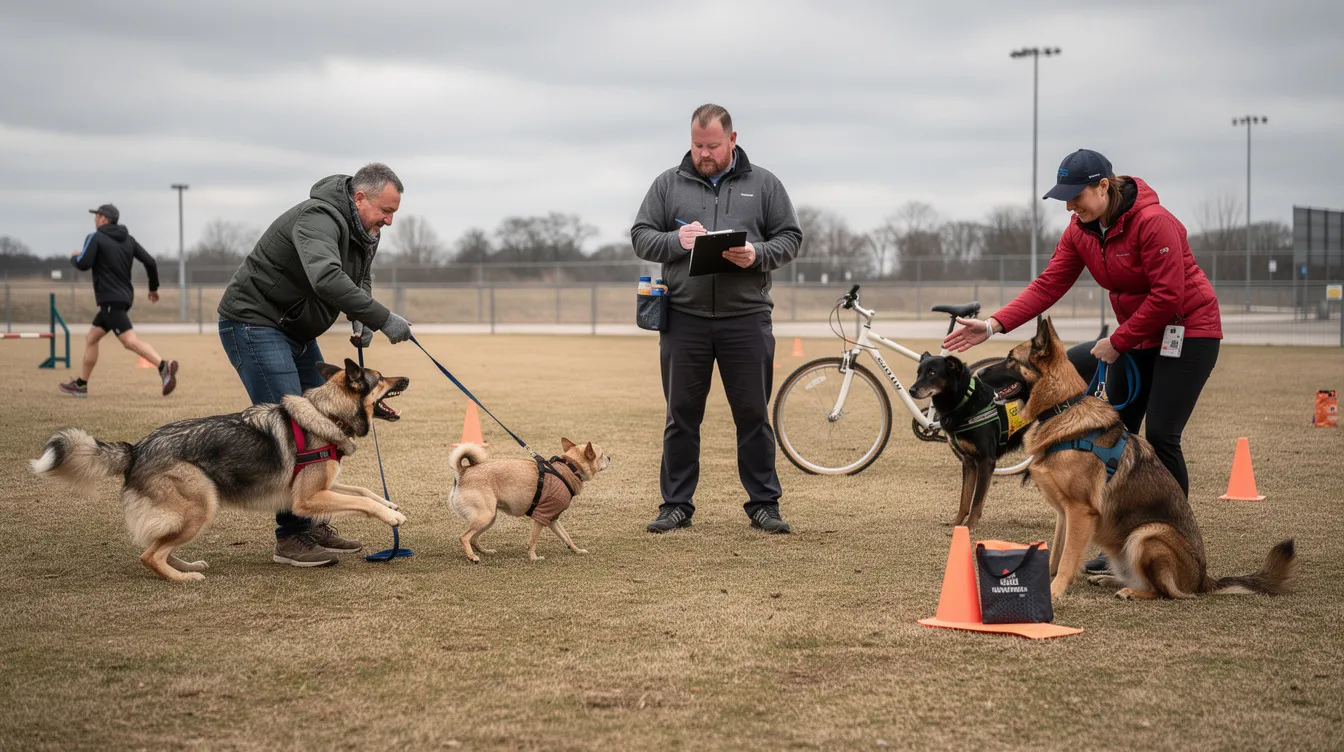
Not all types of reactivity respond to training at the same pace. Understanding realistic timelines helps dog owners set appropriate expectations and maintain training consistency through the process. Counter-conditioning pairs triggers with high-value treats so dogs learn to associate triggers with positive experiences-this principle applies across all types, but the speed of progress varies significantly.
Quick-Response Types
Barrier reactivity and some forms of motion reactivity often show significant improvement within 4–6 weeks when management strategies are implemented alongside counterconditioning and desensitization. The reason is straightforward: barriers can be physically modified (covered, blocked, removed), and motion triggers can often be controlled through environmental management-choosing routes without heavy cyclist traffic, walking during off-peak hours, or using a long line in open spaces to maintain safety.
Management prevents dogs from practicing reactive behavior, which is half the battle. Dogs may need to be at least 50 feet from triggers initially, with distance gradually decreased as the dog develops new associations. Consistent training during this period creates rapid gains because the dog’s access to rehearsing old reactive patterns is simultaneously restricted.
Moderate-Difficulty Types
Leash reactivity and visitor reactivity typically require 3–6 months of consistent counter-conditioning and behavior modification. These types demand controlled exposure in a controlled environment where trigger intensity can be carefully managed-working with helper dogs at distance, staging visitor arrivals with cooperating friends, and gradually building the dog’s ability to remain calm in progressively challenging situations.
The training process requires patience. Owners frequently underestimate how long meaningful progress takes. When a dog lunges at the sight of another dog, the emotional response has often been rehearsed hundreds of times. Rewiring that association through positive reinforcement takes repetition across many training sessions in varied contexts. The key is that both you and your dog need to build new habits simultaneously.
Complex Cases
Generalized social reactivity spanning multiple trigger categories, severe sound phobia, and resource guarding with bite history represent complex cases that often require ongoing management alongside long-term behavioral work. Reactivity can escalate into aggression without intervention, particularly in dogs that the University of Lincoln research classified as Cluster 4-high risk across all behavioral dimensions, comprising roughly 10% of their sample of nearly 2,000 owners.
When medication support becomes necessary, a veterinary behaviorist can prescribe anxiolytics or antidepressants to reduce baseline stress hormones and improve the dog’s threshold for triggers. Medication is never a standalone solution-it creates a window where behavior modification can take hold more effectively. Pain-based reactivity is also triggered by physical discomfort or injury, which is why a veterinary exam should always precede or accompany behavioral intervention for complex cases.
Common Identification Challenges and Solutions
Even experienced dog owners often struggle to accurately identify their dog’s reactive behavior. Misidentification leads to mismatched training approaches and slower progress.
Multiple Types in One Dog
Dogs can exhibit multiple types of reactivity simultaneously-a dog with leash reactivity may also have sound sensitivity and resource guarding tendencies. When multiple types coexist, prioritize based on safety risk and daily life impact. A dog that shows aggression toward visitors takes priority over one that barks at squirrels through a window. Focus on one type at a time for better outcomes, as attempting to address everything simultaneously overwhelms both the dog and owner and fragments the training plan.
Mistaking Excitement for Aggression
Owners frequently confuse frustrated excitement with aggressive reactivity, and the distinction matters enormously. When a dog reacts to another dog with loose, wiggly body language, play bows mixed with barking, and a wagging tail, that’s likely frustration-the dog wants to get to the other dog. Aggressive dogs display rigid posture, hard staring, closed mouth with lips pulled forward, growling, and snapping. The dog’s body language tells the real story, but reading it accurately takes practice. Professional evaluation provides both you and your dog with clarity that prevents months of misguided effort. Being your dog’s advocate means accurately representing their emotional state rather than projecting human assumptions onto their behavior.
Trigger Stacking Effects
Trigger stacking occurs when multiple mild stressors accumulate-the dog is tired, it’s humid, the leash is tight, an unfamiliar dog is approaching from across the street, and the owner is tense. Individually, none of these would push the dog over threshold. Together, they create an explosive reactive episode that seems to come from nowhere.
Owners often misinterpret trigger stacking as unpredictable reactivity when it is actually a predictable accumulation of environmental factors. Tracking your dog’s triggers across situations reveals that these seemingly random reactive outbursts follow patterns. If your dog is more reactive on busy Saturday mornings than quiet Tuesday evenings, trigger stacking-not randomness-is the likely explanation. The solution involves reducing overall stress load: shorter walks during high-stimulus periods, choosing quiet routes, and ensuring the dog has adequate rest and decompression time. Walking during off-peak hours and avoiding crowded spaces can dramatically reduce the frequency of stacked-trigger episodes.
Conclusion and Next Steps
Accurate identification of your dog’s reactivity type-or types-is the foundation of effective reactive dog training. A leash-reactive dog driven by frustration needs distance management and impulse control work. A sound-sensitive dog needs gradual desensitization and a safe retreat. A resource guarder needs structured protocols that build trust rather than confrontation. Understanding the specific type transforms a reactive dog from an overwhelming problem into a solvable training challenge. Reactivity is not a life sentence.
Take these immediate steps:
- Observe and document your dog’s specific triggers, the environmental factors present during each reactive episode, and the dog’s body language before, during, and after reactions
- Identify the primary type using the seven categories above, noting whether fear or frustration appears to be driving the behavior
- Implement basic management immediately-create distance from known triggers, modify your environment to reduce barrier exposure, and adjust walk times and routes
- Seek professional assessment from a qualified trainer who can evaluate your dog’s behavior in person and design a customized training plan
If you’re in the Albany area, Albany Off Leash K9 Training offers behavioral consultations specifically designed for reactive dogs, including board-and-train programs for dogs that need intensive, structured intervention in a controlled environment.
For related reading, explore why dogs react to other dogs on walks, threshold management techniques, and counter conditioning and desensitization protocols that form the core of most successful desensitization training programs.
Additional Resources
Body language signals to watch for in reactive dogs:
- Whale eye (showing whites of eyes), lip licking, yawning outside of tiredness, stiff tail carriage, raised hackles, hard staring, freezing mid-movement, closed mouth with tension around the jaw
Trigger tracking template – record for each reactive episode:
- Date, time, and location
- What triggered the reaction (be specific: “large black dog at approximately 30 feet” rather than “another dog”)
- Your dog’s body language before the reaction (early signs)
- The intensity and duration of the reaction
- What ended the episode (you moved away, trigger left, dog self-settled)
- Environmental factors (weather, noise level, time since last meal/rest, other stressors present)
Professional support: For behavioral consultations, customized training plans, and off leash dog training programs in the Albany, Schenectady, and Troy area, contact Albany Off Leash K9 Training to discuss your dog’s specific needs.