

Introduction
The leave it command teaches your dog to disengage from any object, person, or distraction and redirect attention back to you. It is one of the most important skills in dog training-a simple command that can prevent your pup from eating chicken bones off the street, chasing wildlife, or lunging toward other dogs on a walk. Whether you have a young puppy just learning the basics or an adult dog that needs better self-control, this guide covers everything you need to know.
This content walks through foundational concepts, practical training methods, and a proven step-by-step protocol for building a reliable leave it response in real-world situations. It is designed for dog owners of all experience levels, with particular relevance for those in the Albany, NY area looking for professional-grade results.
The command “leave it” tells dogs to ignore an object before they reach it. Unlike “drop it,” which commands dogs to release an item already in their mouth, “leave it” is anticipatory-it asks your dog to make a choice not to engage in the first place. Both commands are essential for dog safety, but leave it is the proactive one that prevents problems before they start.
By the end of this guide, you will understand:
- How to teach your dog the leave it command from scratch using a progressive, balanced method
- Why impulse control is the foundational skill behind leave it and advanced off-leash obedience
- How to proof the command across environments so your dog responds reliably during walks, at parks, and around distractions
- When and how tools like e-collars enhance distance control and emergency reliability
- How to troubleshoot common challenges like rushing, inconsistency, and high-drive dogs that ignore the cue
Understanding the Leave It Command
The leave it command is an active disengagement cue. It asks your dog to stop pursuing, sniffing, or approaching something and to look to you instead. This is fundamentally different from passive commands like “stay” or “wait,” which hold a dog in position. Leave it requires the dog to make a decision-to turn away from something appealing and choose the handler.
Core Principle of Impulse Control
At its core, the leave it command builds impulse control and decision-making. When your dog starts moving toward a tasty treat on the ground, and you say “leave it,” you are asking for two things simultaneously: motor inhibition (stopping the approach) and attentional control (shifting focus back to you). A strong leave it command enhances a dog’s self-control across many situations.
Research underscores why this matters. A 2025 study by Singer et al. involving 49 dogs found that training impulse control in one context-such as holding a long “stay” with distractions-did not generalize to other self-control tasks unless those contexts were explicitly trained. This means you cannot teach your dog to sit and wait patiently at the door and expect that same restraint to transfer to leaving things on the sidewalk. Leave it must be practiced across many environments and with many types of distractions.
At Albany Off Leash K9 Training, the balanced training philosophy emphasizes clear communication between handler and dog. The idea is straightforward: the dog understands exactly what is expected, gets rewarded for making the right choice, and receives fair, consistent guidance when it doesn’t. This builds a relationship where the dog actively wants to respond rather than simply being suppressed.
Safety and Behavioral Benefits
Teaching the leave it command is critical for dog safety. Dogs frequently encounter hazards during walks and outdoor play-dropped food, garbage, dead animals, and toxic substances. The ASPCA Poison Control Center handles hundreds of thousands of poisoning cases in dogs annually, and many involve ingestion of human foods or medications. “Leave it” can save dogs from dangerous foods like chocolate, grapes, cooked bones, and countless other hazards. The leave it command can prevent dogs from eating harmful items before they ever reach the dog’s mouth.
Beyond physical safety, the command supports behavioral modification for reactive or anxious dogs. A dog that reacts to other dogs, cyclists, or wildlife can be taught to disengage calmly rather than escalating. When combined with leash training and environmental management, leave it becomes a core tool for reshaping a dog’s behavior around triggers.
Foundation for Advanced Training
Leave it is not an isolated trick. It forms the foundation for off-leash reliability and strong recall. A dog that can ignore high-value distractions on command is a dog that can be trusted at distance, in public, and around unpredictable situations. Using “leave it” can improve a dog’s recall in distracting situations because the underlying skill-choosing the handler over the environment-is the same. This connection to recall under distraction makes leave it one of the highest-value commands you can teach.
With that foundation established, the next step is understanding the specific methods and tools that make leave it training effective.
Training Methods and Tools
Albany Off Leash K9 Training uses a balanced approach that combines positive reinforcement with structured tools to build reliability across all contexts. This is not about choosing one method over another-it is about using the right tool at the right stage of training.
Positive Reinforcement Foundation
Every leave it command begins with positive reinforcement. Start teaching leave it with treats in your hand. Use high-value treats like chicken or cheese as rewards, and lower-value treats as temptation items. The principle is clear: when the dog ignores the temptation, it earns something better.
Clicker or marker-word timing is essential here. The moment the dog turns away from the temptation-even for a few seconds-you mark that behavior with a “Yes!” or a click, then immediately reward with the high-value treat. This precision in timing solidifies the connection between leaving things alone and receiving praise and food. Training sessions should be short and engaging for effectiveness: five to ten minutes, two to three times per day.
Dogs should not be rewarded with the item they are told to leave. This is a critical point that many owners miss. If your dog likes a particular toy and you tell it to “leave it,” the reward must come from you-a different treat, a different toy, or enthusiastic praise-not the forbidden object itself. Rewarding with the left item teaches the dog that persistence pays off.
E-Collar Integration for Reliability
For distance control and distraction-proofing, e-collar training paired with positive reinforcement provides an additional layer of communication. A controlled study with 63 dogs comparing three training groups-e-collar, same trainer without e-collar, and purely positive reinforcement-found that all groups improved in recall and obedience tasks over five days. Differences were modest when the e-collar was used under best practices, demonstrating that professional, calibrated use achieves comparable results without compromising welfare.
E-collar integration is particularly valuable for leave-it-at-a-distance, where leash pressure and body blocking become impractical. Picture your dog 30 feet ahead on a trail, approaching roadkill. A verbal cue paired with low-level e-collar stimulation provides timely, clear communication that the dog associates with the “leave it” word. As the dog turns away, the stimulation stops, and a reward follows. Over time, the verbal cue alone becomes sufficient.
Albany Off Leash K9 Training typically waits until dogs are roughly five months old before introducing e-collars, ensuring sufficient maturity and readiness. The distinction between modern e-collars and old-style shock collars is important-modern tools offer vibration, tone, and precisely calibrated low static pulses.
Equipment and Setup Requirements
Essential training tools organized by phase:
- Treats: Two types-low-value treats (kibble, plain biscuits) for temptation and high-value treats (chicken, cheese, freeze-dried liver) for reward
- Clicker or marker word: A consistent “Yes!” or click to mark correct behavior
- Leash and collar/harness: Short leash for indoor work, long line for outdoor proofing. Use a leash to control your dog during leave-it training
- E-collar: Modern, adjustable, humane design-introduced only after verbal foundations are solid and under professional guidance
- Controlled environment: Start in a quiet room with minimal distractions; complexity increases as the dog progresses
Avoid using genuinely dangerous items during initial training stages. Use safe food and toy substitutes while building the behavior.

Step-by-Step Training Protocol
This protocol follows Albany Off Leash K9 Training’s proven progression from foundation to advanced real-life application. Each phase builds on the previous one, and advancing too quickly is the most common mistake owners make.
Phase 1: Foundation with Treats in Hand
Begin indoors in a quiet room with no distractions. This phase establishes the basic association: leaving things alone leads to something better.
- Closed fist presentation: Hold a small treat in your closed fist. Present it to your dog. The dog will lick, nose, and paw at your hand. Wait without speaking. The moment the dog pulls its nose away or looks up at you, mark with “Yes!” and reward with a high-value treat from your other hand.
- Add the verbal cue: Once the dog reliably disengages from the closed fist, say “Leave it” before presenting your hand. Then open your fist slightly. If the dog moves toward the treat, immediately close your hand. Wait for disengagement, mark, reward.
- Progress to open palm: Place the treat on your open palm. Say “leave it.” If the dog lunges, quickly cover the treat by closing your hand. When the dog ignores the open hand for a few seconds, mark and reward from the other hand. Gradually increase the duration the dog must wait patiently before receiving the reward.
- Build duration: Teach your dog to wait for at least 20 seconds with the treat visible on your open palm before marking and rewarding.
Session guidelines: Keep each session to 5–10 minutes. Repeat two to three times daily. Progress to Phase 2 when your dog achieves roughly 80–90% success across multiple sessions.
Phase 2: Ground-Level Distractions
This phase transitions the exercise from your hand to the ground, which is where real-world challenges occur.
- Covered floor treats: Place a low-value treat on the floor and cover it with your hand or foot. Say “leave it.” When the dog ignores the covered treat and looks at you, mark and reward with a high-value treat. Gradually increase difficulty by placing treats on the floor uncovered.
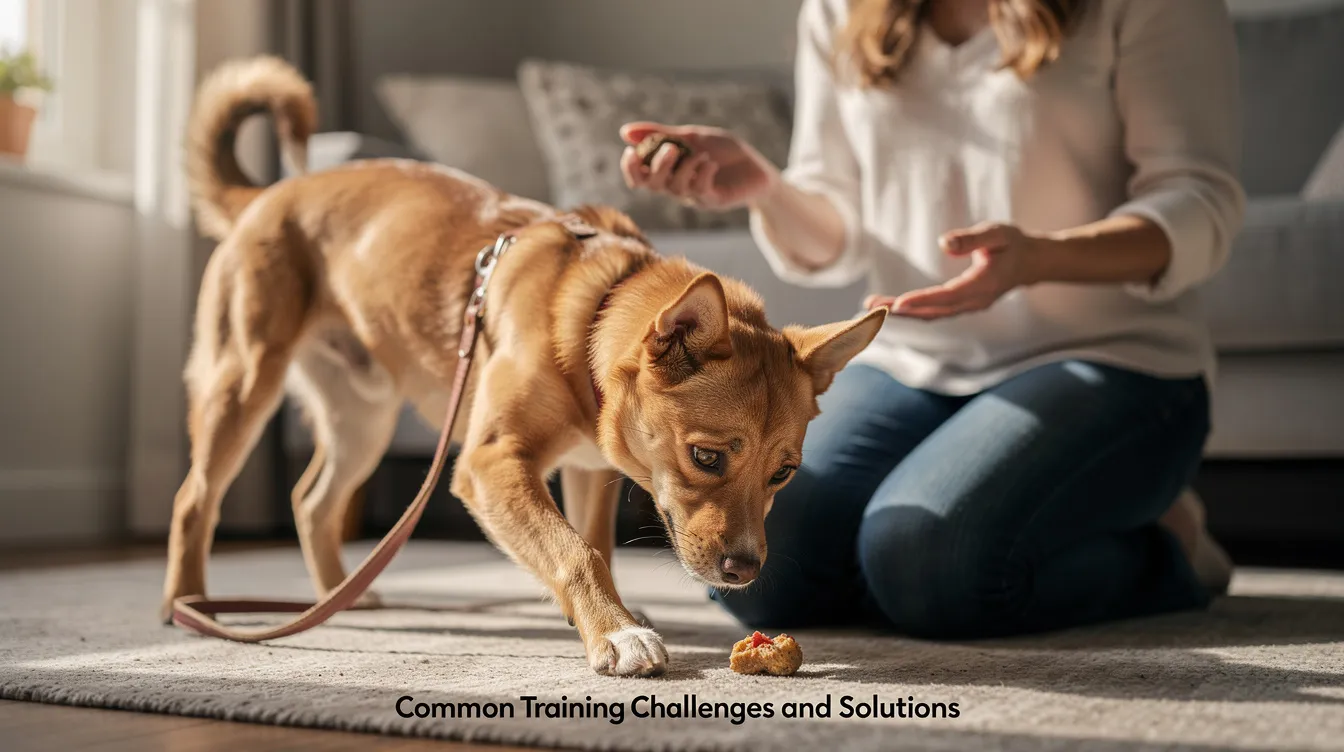
- Visible temptations: Place a tasty treat on the ground in clear view. Use leash management to prevent the dog from reaching it. Say “leave it.” Mark and reward the moment the dog looks away. Practice leave it with distractions like food on the ground until the response becomes automatic.
- Increase value and proximity: Gradually increase the difficulty by moving the treat closer to the dog. Use items your dog loves-real food, wrappers, other objects that mimic what you encounter outside. The dog should begin paying attention to you rather than the item on the floor.
- Add movement: Walk past the temptation item with your dog on leash. When the dog ignores it on cue, reward immediately.
Advancement criteria: The dog consistently ignores high-value items on the ground, redirects to you without leash tension, and responds on the first cue in at least 80% of attempts.
Phase 3: Real-World Proofing
Practice leave it in various environments to ensure reliability. This is where trained dogs are distinguished from dogs that only perform in the living room.
- Environmental progression: Move from the quiet room to the yard, then to the sidewalk, then to busy areas. Each new environment requires a slight reset in expectations-the dog may need more help initially.
- Natural distractions: Practice with real temptations: dropped food on the street, garbage, other dogs walking past, squirrels, and moving objects like bikes. Training leave it helps dogs ignore distractions during walks.
- Distance work: With the verbal cue solid, introduce the e-collar at low levels for distance proofing. Pair “leave it” with low stimulation; as the dog turns away, stimulation stops, and reward follows. Over time, the verbal command alone should suffice.
- Release criteria: The dog does not move toward forbidden objects, looks to the handler, and dog ignores even high-value distractions reliably-including at distance without leash tension.
| Distraction Level | Environment | Tools | Expected Response |
|---|---|---|---|
| Low | Quiet room | Treats, clicker | Dog turns away within 1–2 seconds |
| Medium | Yard, sidewalk | Treats, leash, long line | Dog ignores item, redirects to handler |
| High | Park, busy street | Leash, e-collar backup, high-value rewards | Dog responds on first cue, maintains focus |
| Extreme | Wildlife, other dogs, dropped food | E-collar, verbal cue, handler positioning | Immediate disengagement, handler check-in |
Common Training Challenges and Solutions
Even with a solid protocol, specific obstacles arise regularly. Here are the most common challenges based on Albany Off Leash K9 Training’s client experience and how to address them.
Dog Rushes Past Handler to Object
This typically happens when the handler delivers the cue too late or when the initial distance between dog and object is too small. The dog picks up momentum before the command registers.
Solution: Reset to an earlier foundation phase. Use a leash or body block to prevent the dog from reaching the item. Deliver “leave it” before any movement toward the object-not during the lunge. Increase the distance between your dog and the temptation. Reward immediately for even a brief look away. Standing between the dog and the distraction can help interrupt the pattern while you rebuild the response.
Inconsistent Response to Command
The dog responds sometimes but not others. Common causes include progressing too quickly through phases, insufficient reinforcement, or practicing in only one environment. As research confirms, impulse control is context-specific-a dog that leaves treats alone indoors may completely fall apart outdoors.
Solution: Return to the proofing level where the dog was last consistently successful. Rebuild with high reinforcement rates. Then gradually fade treats using an intermittent reinforcement schedule-random rewards maintain behavior more effectively than predictable ones. Practice in multiple environments so the dog generalizes the word across contexts. If you notice regression in your puppy’s training, do not interpret this as failure-it is a normal part of the learning process that requires patient repetition.
High-Drive Dogs Ignoring Cue
Working breeds, herding breeds, and sighthounds with strong prey drive present a particular challenge. When a dog starts fixating on a moving target, the reward value of the chase can overwhelm anything you offer.
Solution: Use higher-value rewards that compete with the distraction-real meat, a favorite toy, or an exciting play session. Keep sessions short but frequent. Integrate an e-collar after the verbal cue is solid, providing a clear communication channel that cuts through arousal. Combine physical management (leash, long line) with structured exercises. For dogs that remain unresponsive despite consistent effort, a professional board-and-train program provides the intensive, immersive environment needed to break through resistance. When professional board-and-train programs become necessary, the structured daily repetition accelerates results in ways that weekly sessions cannot match.
Conclusion and Next Steps
The leave it command is far more than a fun party trick. It is a foundational safety skill, an exercise in building genuine impulse control, and the gateway to advanced obedience and off-leash reliability. When your dog can ignore a high-value treat on the ground, walk past chicken bones on the sidewalk, and disengage from other dogs on command, you have a pet that is safe, responsive, and a pleasure to live with.
Start today with Phase 1 foundation work:
- Gather your low-value and high-value treats
- Find a quiet room with no distractions
- Practice the closed-fist exercise for 5–10 minutes
- Repeat two to three times daily until your dog reliably turns away on the “leave it” cue
If you want personalized guidance, Albany Off Leash K9 Training offers private lessons and structured programs tailored to your dog’s breed, age, and temperament. For dogs that need intensive work-especially high-drive or reactive dogs-their board-and-train programs build off-leash obedience and impulse control in real-world environments throughout the Albany area.
The leave it command connects directly to broader training goals: reliable recall under distraction, behavioral modification for aggression, and the kind of calm, confident dog behavior that makes every walk and every moment together more enjoyable.
Additional Resources
- Struggling with impulse control? Albany Off Leash K9 Training offers free consultations to assess your dog’s current training level and recommend the right program
- Ready for advanced obedience? Their programs build on the leave-it foundation to achieve full off-leash reliability in public settings-explore all available services
- New puppy owner? The leave-it command is one of the first skills covered in their puppy training programs, designed for dogs starting as young as eight weeks
- Want to understand e-collar training? Read their guide on why positive reinforcement with e-collar training works for a deeper look at the balanced approach